Your hips do not care how motivated you are. If they are stiff, your squat gets cut short, your stride gets choppy, and your low back usually starts picking up work it should not be doing. For athletes and active adults, learning how to improve hip mobility is less about chasing flexibility and more about restoring clean movement under load, speed, and fatigue.
That distinction matters. A loose joint without control is not useful in sport. On the other hand, a strong athlete with limited hip motion will eventually run into compensation patterns, recurring tightness, or performance plateaus. Better hip mobility means your body can access positions it actually needs, then control those positions when it counts.
What hip mobility really means
Hip mobility is the combination of available motion and usable control at the hip joint. It includes flexion, extension, internal rotation, external rotation, abduction, and adduction. If one of those pieces is restricted, something else usually starts compensating. Common substitutes are the low back, knees, or feet.
This is why two people can feel the same “tight hips” and need completely different solutions. One athlete may lack internal rotation and struggle with sprint mechanics or deceleration. Another may have enough passive range but poor strength in end ranges, so the body protects itself by creating stiffness. In both cases, stretching harder is not automatically the answer.
For runners, limited hip extension can shorten stride and increase stress through the front of the hip or low back. For lifters, restricted hip flexion or rotation can change squat mechanics and shift force where you do not want it. For field and court athletes, poor rotational control often shows up during cutting, change of direction, and single-leg loading.
Why your hips feel tight in the first place
Most hip stiffness comes from a mix of training load, tissue tone, movement habits, and joint limitations. Sitting for long periods can contribute, but for active people, the bigger issue is usually repetitive stress in the same patterns without enough variability or recovery.
If you run, cycle, lift, and sit at work, you spend a lot of time in hip flexion. That can leave the front of the hips feeling dense and the glutes underperforming. If you train hard but skip recovery, surrounding muscles may stay guarded. If your pelvis and rib cage are not well positioned, the hips may lose access to clean rotation even when the tissues themselves are not especially short.
There is also a structural piece. Not every hip is built the same. Some athletes can drop deep into a squat naturally. Others have bony anatomy that makes certain positions less available. That does not mean you are broken. It means your mobility work needs to respect your build instead of forcing textbook positions that do not fit your body.
How to improve hip mobility without wasting time
If you want to know how to improve hip mobility in a way that carries over to training, use a three-part approach: reduce excess tension, restore range, and build strength in that range. Skip one of those steps and the change usually does not stick.
Start with the restriction you actually have
Before adding drills, identify what feels limited. Is it the front of the hip in extension, the groin in lateral movement, or the deep pinch that shows up in flexion? Does your right side move differently than your left? Do you feel stiffness only after hard sessions, or all the time?
A simple screen helps. Check a bodyweight squat, a half-kneeling hip flexor position, a 90/90 seated rotation test, and a single-leg hinge. You are not looking for perfection. You are looking for where motion stops, where compensation begins, and whether the issue is range, control, or both.
Use soft tissue work with purpose
Manual therapy, targeted release work, and breathing-based resets can reduce the tone that blocks motion. This is where many athletes get quick relief, especially in the hip flexors, adductors, glutes, TFL, and deep rotators. But relief is not the finish line. If you open the range and then go right back to the same pattern without reinforcing it, the body often returns to its old default.
A few focused minutes can help before mobility drills. Think less about smashing tissue and more about reducing the noise enough for the joint to move better. If aggressive foam rolling leaves you more irritated than mobile, back off.
Train the motions most people avoid
The hips need rotation, not just stretching in a straight line. A lot of athletes hammer hip flexor stretches and still wonder why they move poorly. Rotation is often the missing piece.
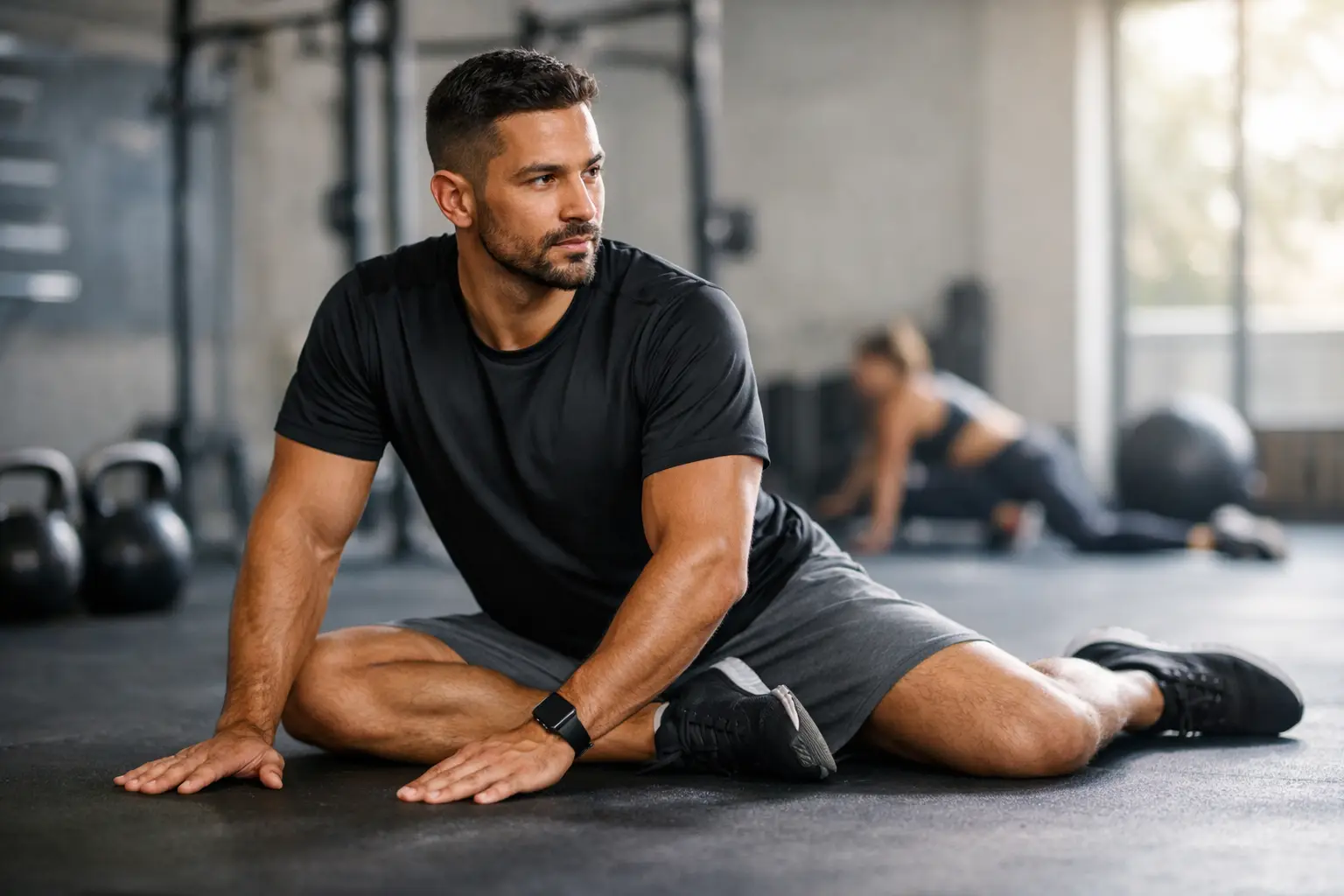
The 90/90 position is useful because it trains both internal and external rotation. Controlled transitions from side to side teach the hips to rotate without the spine taking over. Prying in a deep squat can help if your anatomy allows it, but it should feel productive, not jammed. Split squat variations can open hip extension while building strength and balance.
A practical sequence might include 90/90 switches, an adductor rock-back, a half-kneeling hip flexor stretch with glute engagement, and a controlled squat hold. Done well, that covers rotation, groin length, extension, and loaded flexion.
Strength is what makes mobility usable
This is where most mobility programs fall apart. You gain a little range in a warm-up, then lose it because you never trained your body to own it. Strength work is what turns temporary access into a repeatable movement skill.
Single-leg RDLs, split squats, lateral lunges, step-downs, and Copenhagen variations all build hip control in ranges that matter. Tempo helps. Pauses help. End-range isometrics help even more. If your adductors cramp during controlled work, that is often a sign they are weak in the range, not just tight.
For athletes, this is the standard: if you want your hips to move well at speed, they need to be strong in rotation, stable in single-leg positions, and coordinated with the trunk. Mobility without strength is too fragile for sport.
A simple weekly plan that works
You do not need an hour a day. Most people get better results from short, consistent sessions than occasional marathon mobility work.
Before training, spend 6 to 10 minutes opening the ranges you need for that session. On lower-body days, prioritize hip flexion, rotation, and adductor length. Before sprinting or field work, include hip extension and dynamic rotational prep.
After training or on recovery days, use lower-intensity work to restore motion and downshift tissue tone. This is where longer holds, breathing, assisted stretching, or targeted bodywork fit best. Two to four strength-based mobility exercises can stay in your program year-round.
If you sit a lot during the day, brief movement breaks matter. A few reps of 90/90 transitions, a split squat stretch, or a loaded carry can interrupt the stiffness cycle better than waiting until evening to attack it all at once.
When stretching is not enough
If you feel pinching in the front of the hip, recurring low back tightness during hip drills, or major left-right differences that do not improve, generic mobility routines may not solve the problem. Sometimes the issue is joint mechanics, old injury history, pelvic control, or tissue restriction that needs hands-on treatment.
That is where integrated work tends to move faster. Manual therapy can reduce guarding, assisted stretching can improve access, and strength coaching can lock in the change. For active adults and athletes in Miami, that combination is often more productive than separating recovery from training. Roman Balaban Massage Therapy & Fitness Training is built around that exact model.
Mistakes that keep hips stiff
The biggest mistake is doing random stretches with no plan. The second is pushing into pain and calling it mobility work. Sharp pinching, joint irritation, and low back compensation are not signs that the drill is working.
Another common problem is skipping breathing and trunk position. If your ribs flare and pelvis dumps forward, your hips may look blocked even when the joint itself is capable. Clean positioning can change what the hips have access to immediately.
Finally, do not confuse soreness with progress. Good mobility work should leave you moving better, not feeling beat up for two days.
What progress should feel like
Better hip mobility usually shows up in training before it shows up in a dramatic stretch photo. Your squat feels smoother. Your stride opens up. You can hinge and rotate without the low back getting stiff. Recovery between hard sessions improves because force is being distributed more cleanly.
That is the real goal. Not circus-level range. Not forcing positions your body does not own. Just hips that move well enough to let you train hard, recover faster, and stay durable.
Treat mobility like performance maintenance, not an afterthought. A few smart inputs done consistently will outperform random stretching every time.
Leave a Reply