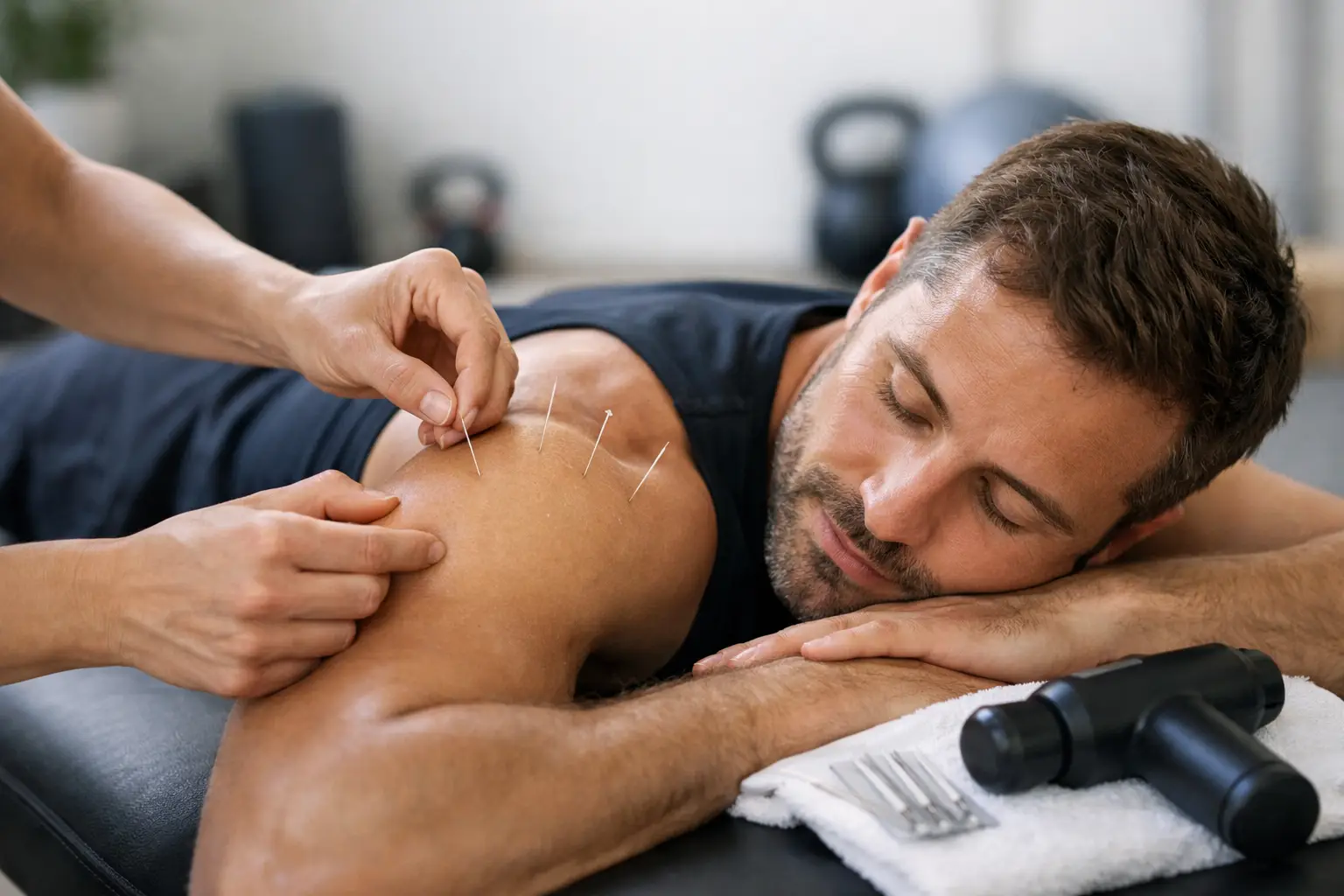
A runner whose calf locks up late in a long run, a lifter who cannot get comfortable at the bottom of a squat, and a soccer player carrying persistent hamstring tightness all ask the same question: does dry needling help recovery? It can be a useful tool when muscle pain, guarding, or a movement restriction is limiting training. But it is not a shortcut around poor load management, inadequate sleep, or an injury that needs a different plan.
For active adults, recovery is not simply feeling looser for an hour. It means restoring enough range of motion, force production, and confidence in movement to train productively again. Dry needling can support that goal when it is used with a clear assessment and followed by the right mobility, strength, and training decisions.
Does dry needling help recovery? It depends on the problem
Dry needling uses a thin, solid needle to target sensitive areas in muscle and related tissue. A trained practitioner may use it around an active trigger point, a guarded muscle, or tissue that is contributing to a painful movement pattern. The needle itself does not “flush toxins,” repair a tendon, or erase a training error. Its practical value is often reducing pain sensitivity and muscle guarding long enough to improve movement.
That distinction matters. If your upper trap is constantly braced after heavy pressing, temporary pain reduction may help you restore shoulder mechanics and train without compensating. If you have a grade-two hamstring strain, however, a needle cannot replace a progressive loading plan. In that situation, recovery depends on respecting tissue healing, rebuilding strength at longer muscle lengths, and returning to sprint demands in stages.
Research and clinical experience suggest dry needling may provide short-term improvements in pain and range of motion for some musculoskeletal complaints. The response varies. Some athletes feel a meaningful change after one session; others need a broader approach because the tightness is a symptom, not the source of the problem.
What athletes may notice after a session
When dry needling is appropriate, the most useful outcome is not soreness for its own sake. It is a measurable change: less pain when rotating the hip, a deeper squat without pinching, a more relaxed stride, or improved access to an exercise that had become limited.
During treatment, you may feel a brief twitch response or local ache. Afterward, the area can feel sore, similar to post-training muscle soreness, for 24 to 48 hours. Many athletes also report that the muscle feels less protective and easier to move. That window is where good recovery work matters most.
A productive follow-up might include controlled hip mobility after glute work, calf loading after treatment for a restricted ankle, or light rotator cuff and scapular work after addressing shoulder tension. The goal is to teach the body how to use the new range of motion, not just enjoy it on the treatment table.
Recovery improves when treatment matches training load
An athlete can get temporary relief from dry needling and still recreate the same problem within days. A runner adding mileage, speed work, and hills at once may continue to overload the calf. A racquet sport athlete with limited thoracic rotation may keep stressing the elbow or shoulder. A lifter whose squat breaks down under fatigue may continue to irritate the same hip or back tissues.
That is why dry needling works best as part of an integrated recovery plan. Assessment should look beyond the painful spot. What changed in your training volume? Which positions are limited? Can you control the range you have? Is the muscle tight because it is overworked, or because another area is not doing its job?
For example, chronic hip flexor tightness may be connected to long hours sitting, but it may also reflect poor trunk control, limited hip extension, or aggressive sprint volume. Needling may reduce the feeling of restriction. Strength work, sprint progression, and better warm-up choices are what make that improvement durable.
When dry needling can be a strong fit
Dry needling is often most helpful for athletes dealing with persistent muscle tone or pain that is interfering with normal movement. Common examples include calves that restrict ankle motion, glutes that remain guarded after hard training, upper back and neck tension affecting overhead work, or quads that limit knee comfort after a demanding block.
It can also be useful during return-to-training phases when an athlete has been protecting an area for too long. Once a clinician has ruled out a more serious issue, reducing guarding can make it easier to reintroduce loading with better mechanics.
At Roman Balaban Massage Therapy & Fitness Training, dry needling is most effective when it is paired with hands-on work, assisted stretching, and targeted corrective exercise. The needle is not the entire session. It is one option within a system built to improve movement quality and prepare the athlete for the demands ahead.
When it is not the right answer
Do not treat dry needling as the default solution for every ache. Sudden swelling, instability, numbness, progressive weakness, fever, unexplained pain, or a suspected fracture requires medical evaluation. Sharp joint pain and symptoms that worsen with normal activity may point to a condition that needs a different diagnosis and plan.
Dry needling also requires appropriate screening. Tell your provider about blood thinners, bleeding disorders, pregnancy, immune concerns, needle anxiety, recent surgery, skin infection, or a history of fainting. The treatment should be performed by a properly trained, licensed professional operating within their scope of practice.
Timing matters as well. A hard session immediately after treatment is not always smart, especially if the area is sore or you are still learning how your body responds. For many athletes, light movement, hydration, and an easy recovery day are more productive. If you have competition coming up, plan treatment far enough ahead to avoid unnecessary post-session soreness.
Use the post-treatment window well
The value of any recovery treatment is determined partly by what you do next. After dry needling, move through the range that was limited, then load it at an appropriate level. Keep the work simple and specific. If your ankle now dorsiflexes more easily, use controlled calf raises, split squats, or walking drills. If your shoulder moves more freely, reinforce it with quality pulling, pressing, and scapular control.
Pay attention to the response over the next 24 to 48 hours. Better movement with less pain is useful information. Rebound tightness after every hard session is also useful information: your training dose, technique, recovery habits, or strength capacity may need attention.
Sleep, nutrition, and sensible programming still do the heavy lifting. Protein and total calorie intake support adaptation. Carbohydrates help replenish hard-working athletes. Sleep improves recovery capacity, coordination, and pain tolerance. None of those fundamentals are replaced by a needle, a massage gun, or a single treatment.
The performance standard: better movement you can keep
The right question is not whether dry needling feels intense or provides immediate relief. Ask whether it helps you move better, load better, and return to training with fewer compensations. If the answer is yes, it has a place in your recovery plan. If the change disappears because the underlying training problem remains untouched, the plan needs to get more precise.
Recovery should build a more durable athlete, not create dependence on treatment. Use dry needling when it creates a meaningful opening for better movement, then use that opening to strengthen, train, and perform with control.
Leave a Reply