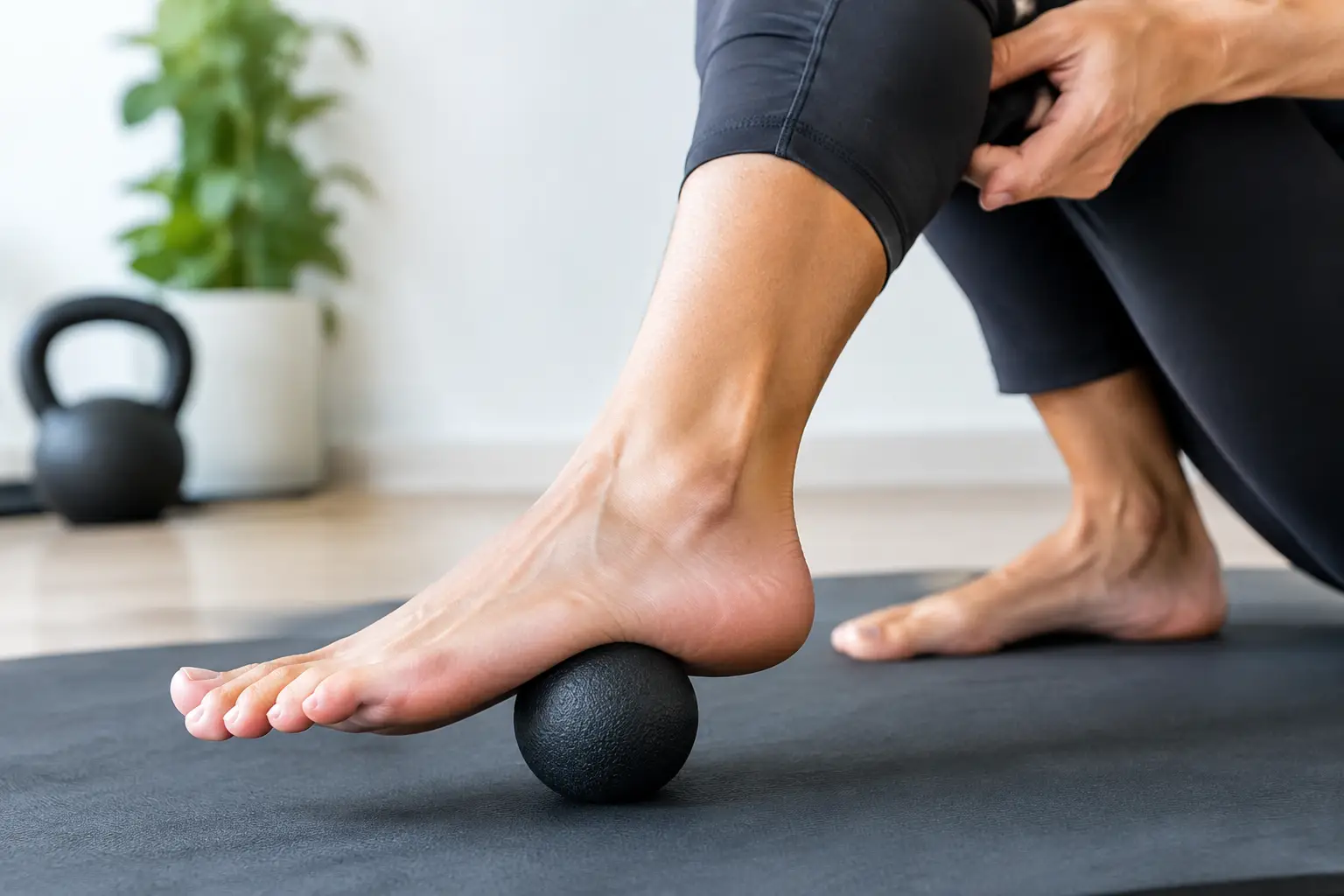
The first few steps out of bed should not feel like a test of your pain tolerance. Neither should the first acceleration in a soccer match, the push-off in a run, or a hard landing after a jump. Myofascial work for plantar fascia pain is not about aggressively digging into the sore spot. It is a targeted approach to restoring how the foot, ankle, calf, and lower leg manage load.
For athletes and committed gym-goers, plantar fascia symptoms rarely exist in isolation. The foot may be irritated, but the driver can include limited big-toe motion, stiff calves, poor ankle control, abrupt training-volume changes, or a strategy of forcing more work through the foot because the hips are not contributing well enough. Effective treatment needs to account for the entire chain.
Why the Plantar Fascia Gets Overloaded
The plantar fascia is a thick band of connective tissue running from the heel toward the toes. It helps support the arch and transfers force as you walk, run, cut, jump, and lift. It is designed to store and release energy. Problems start when the tissue repeatedly absorbs more stress than it can recover from.
That can happen after a sudden jump in mileage, more court time, a change in shoes, increased hill work, or long shifts spent standing. It can also develop more gradually when the ankle loses dorsiflexion, the calf stays chronically restricted, or the big toe cannot extend efficiently during push-off. The body still needs to move forward, so it finds motion somewhere else. Often, the plantar fascia pays for it.
Pain near the inside of the heel, especially during the first steps after rest, is a common pattern. But self-diagnosis has limits. Heel pain can also involve a nerve, a bone stress injury, a fat-pad issue, or another condition that needs different management. Persistent pain, swelling, numbness, bruising, pain at rest, or an inability to bear weight deserves evaluation by a qualified medical professional.
What Myofascial Work for Plantar Fascia Actually Does
Myofascial work uses hands-on pressure, movement, and tissue-specific techniques to address restrictions and sensitivity in the fascia and surrounding soft tissue. The goal is not to “break up” fascia. Fascia is not a knot that needs to be smashed apart. The practical goal is to improve tissue tolerance, reduce protective tension, restore usable motion, and help the athlete move with a better loading strategy.
Direct work on the sole of the foot can be useful, particularly when it is paired with slow toe movement and controlled ankle motion. But direct pressure is only one piece. In many cases, the higher-value work happens in the calf complex, around the Achilles, through the deep muscles of the lower leg, and near the intrinsic muscles that control the foot.
A skilled session may also address the big toe, because limited toe extension can force the foot to compensate during gait and running. It may include the peroneals along the outside of the lower leg, which help control the foot during landing and cutting. Depending on the athlete’s movement pattern, work may extend to the hamstrings, hips, and trunk. The foot is the contact point with the ground, not an isolated structure.
The right amount of pressure matters. More intensity is not automatically better. If treatment leaves the foot more reactive for several days, the dose was probably too high for the current tissue capacity. Productive work should create a noticeable change in mobility or symptoms without turning recovery into another source of stress.
The Calf-Foot Connection Athletes Cannot Ignore
A stiff calf changes how the ankle moves over the foot. If the shin cannot travel forward well during walking, squatting, or running, the body may compensate by collapsing the arch early, turning the foot outward, or lifting the heel too soon. Each workaround can increase demand on the plantar fascia.
This is why rolling the bottom of the foot with a ball may provide temporary relief but fail to solve the pattern. It may calm sensitivity in the area, yet it does not automatically restore ankle range, calf strength, or single-leg control. The relief is real, but it may not be enough to support the next hard training session.
For runners, reduced calf capacity can show up as a shortened stride, early fatigue, or a loss of spring off the ground. For field and court athletes, it can show up during deceleration and re-acceleration, when the foot must stabilize quickly under changing forces. For lifters, limited ankle mobility can shift squat mechanics and increase demand through the foot during loaded patterns.
Manual therapy can improve the starting point. Strength and movement practice make that improvement useful.
Pair Hands-On Work With Load Management
Plantar fascia pain often improves when athletes stop treating recovery and training as separate problems. Myofascial treatment can reduce restrictions and make movement feel better, but the tissue also needs an appropriate loading plan. Complete rest is not always the answer, especially for athletes who need to return to running, cutting, or jumping. The better question is: what level of loading can the foot tolerate today, and how can we build from there?
If morning pain is escalating, pain increases during a session and lingers into the next day, or the foot is getting less tolerant week after week, training load needs adjustment. That does not always mean shutting everything down. It may mean reducing sprint volume, limiting hills, changing jumping exposure, shortening a run, or using conditioning options that do not flare the foot.
As symptoms settle, progressive strength work is critical. Calf raises with controlled tempo, bent-knee calf work for the soleus, foot-intrinsic strengthening, and gradual single-leg loading can all be relevant. Big-toe control and balance work may also matter. The exact plan depends on the sport, the athlete’s current tolerance, and the mechanics that created overload in the first place.
For example, a distance runner with stiff ankles may need calf capacity and a gradual return to speed work. A soccer player may need more emphasis on deceleration, lateral loading, and foot control in cleats. A strength athlete may need to clean up ankle range and foot pressure during squats, lunges, and loaded carries. The diagnosis may have the same name, but the return-to-performance plan should not look identical.
What a Performance-Focused Session Should Include
A productive session begins with assessment, not immediate pressure on the heel. Your practitioner should consider where pain is located, what activities provoke it, when symptoms started, how training has changed, and what your movement looks like under load.
That assessment can include ankle mobility, big-toe extension, calf strength, single-leg balance, foot control, squat mechanics, and gait or running patterns when appropriate. The purpose is not to create an overly complicated checklist. It is to identify the biggest limiter that is keeping the plantar fascia overloaded.
Hands-on work should then be specific. That may include targeted myofascial work through the plantar surface and calf, assisted stretching, and mobility work that immediately transfers into a controlled movement drill. The session should finish with actionable guidance: what to train, what to temporarily modify, and which exercises will build capacity without irritating the tissue.
At Roman Balaban Massage Therapy & Fitness Training, the goal is to connect treatment with the work you need to do afterward. A foot that feels better on the table but fails under running, cutting, or lifting is not fully prepared. Recovery has to carry over to performance.
Common Mistakes That Keep Heel Pain Around
The most common mistake is chasing pain with aggressive self-treatment every day. Hard ball rolling, scraping, or deep pressure can feel productive because it is intense, but irritated tissue does not always respond well to more irritation. Use enough pressure to create a tolerable release, not a bruised foot.
Another mistake is stretching without building strength. Calf stretching may help if ankle range is limited, but flexibility alone will not prepare the foot for a fast run or repeated jumps. Mobility gives you access to motion. Strength and progressive exposure teach you to control it.
Finally, avoid returning to full training simply because symptoms are quieter. Lower pain is a good sign, but capacity still needs to be rebuilt. Test the foot progressively: normal walking, controlled strength work, low-level hopping if appropriate, then sport-specific acceleration, cutting, or distance. Let the next morning’s response guide the pace.
Your plantar fascia does not need random attention. It needs a clear plan: reduce unnecessary overload, restore the movement options your body has lost, and build the strength to handle the demands you choose to place on it.
Leave a Reply