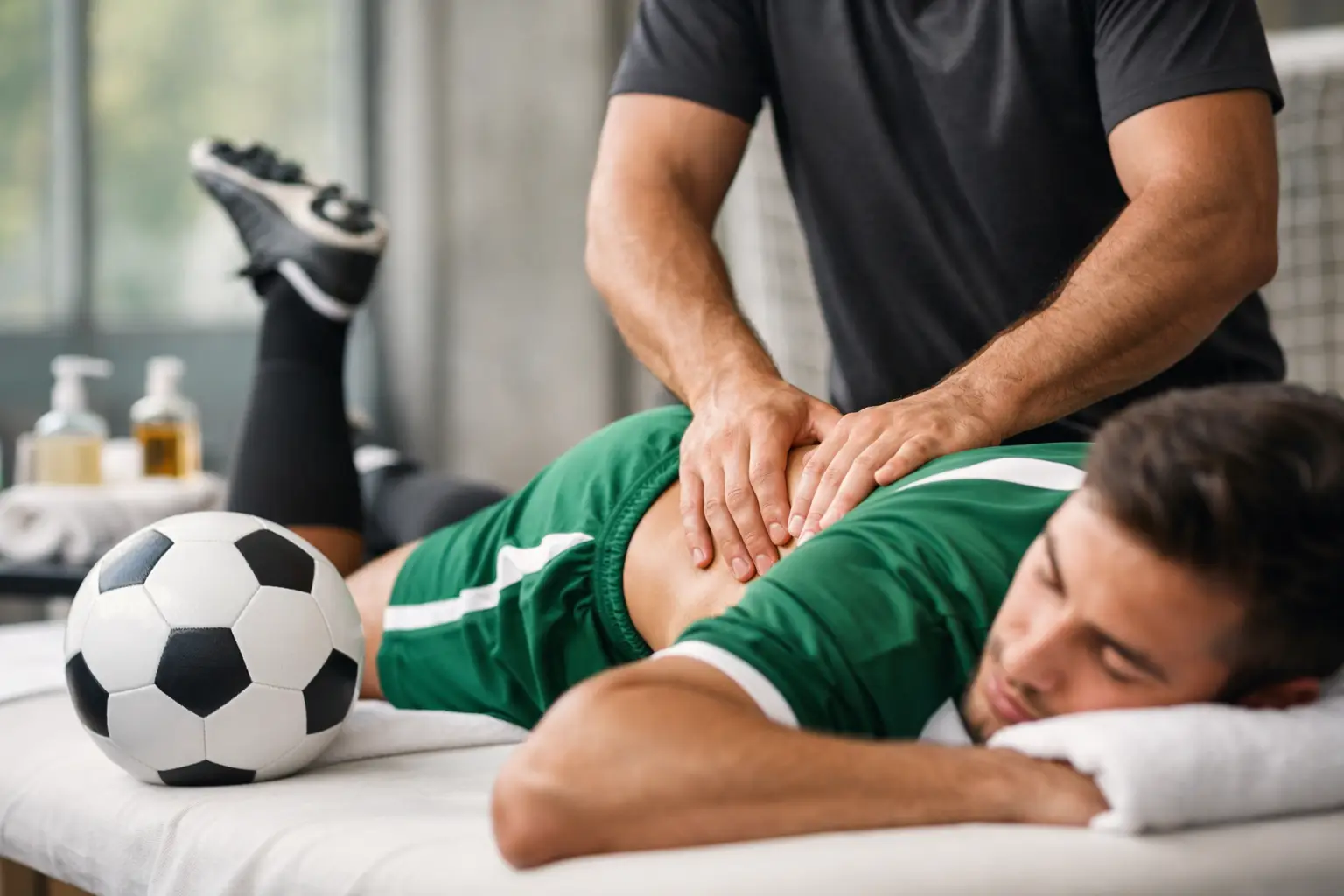
A soccer player does not usually break down from one dramatic moment. More often, performance slips because the body stops moving cleanly. Hips get stiff. Calves stay loaded. Adductors tighten. Rotation disappears. Then sprint mechanics, striking, cutting, and recovery all start to suffer. That is where sports massage for soccer players becomes useful – not as a luxury, but as a practical tool for staying available, explosive, and durable.
Soccer places repeated stress on the lower body, but the demand is not limited to the legs. A player needs hip extension to sprint, adductor strength and length to change direction, trunk rotation to strike and shield, and enough ankle mobility to absorb force and re-accelerate. When tissue quality drops and joint motion gets restricted, the body starts finding workarounds. Those workarounds may keep you playing for a while, but they usually cost speed and increase wear.
Why sports massage for soccer players matters
Soccer is a high-volume sport with constant transitions between acceleration, deceleration, contact, and uneven movement patterns. One week may include matches, practices, strength work, and conditioning, with little time to fully reset between sessions. Even recreational players often carry the same overload patterns as competitive athletes because they train hard, sit too much between sessions, and rarely address tissue restriction until something starts to hurt.
Sports massage helps by reducing excessive muscle tone, improving short-term mobility, and restoring better movement options. That does not mean it magically fixes every issue. If your sprint mechanics are poor or your adductors are weak, hands-on work alone will not solve the problem. But it can reduce the friction in the system so you can move better, train better, and tolerate more work.
For soccer players, the biggest value is often simple. You recover faster after heavy sessions, you feel looser where you normally get bound up, and you can train with better quality instead of carrying yesterday’s fatigue into today’s work.
What areas usually need the most attention
Most soccer players come in with a familiar pattern. The calves and Achilles feel overloaded from repeated running and change of direction. The quads and hip flexors are dense from sprinting and ball striking. The adductors are tight or irritated, especially in players who cut hard, strike frequently, or have a history of groin issues. Glutes may be weak from a training standpoint but still feel guarded and stiff from compensation.
The hamstrings also deserve attention, though not always in the way players expect. A hamstring that feels tight is not always a hamstring that needs aggressive pressure. Sometimes it is overworking because the hips are restricted or because the front side of the body is pulling the pelvis out of position. In those cases, a good sports massage session looks at the chain, not just the sore spot.
The trunk matters too. Limited rotation through the thoracic spine can affect striking mechanics, arm action during sprinting, and how well a player absorbs contact. Neck and shoulder tension can also build up in athletes who train hard and carry a lot of stress outside the field.
What a good session should actually do
A useful session for a soccer player is targeted. It should reflect your training week, current symptoms, movement restrictions, and performance goals. This is not generic full-body relaxation work with a sports label on it.
If you are in-season, the goal is often to reduce accumulated tension without leaving you flat or sore. Pressure, pacing, and tissue selection matter. Too much intensity right before a match can leave the body irritated instead of ready. In that setting, the best work usually improves mobility, calms down overloaded tissue, and gets you moving more freely within a day.
If you are in a heavy training block or coming off repeated matches, deeper tissue work may make sense, especially through the calves, quads, TFL, adductors, and posterior chain. But deeper is not always better. The point is not to win a pain contest. The point is to create a useful change in tissue tone and movement quality.
The best sessions also connect hands-on treatment to what happens next. If hip rotation improves on the table but you go right back to poor mechanics and no strength support, the result will not last. That is why an integrated approach works better for athletes. Manual therapy creates the opening, then mobility, prehab, or strength work helps hold onto it.
Timing matters more than most players think
One reason athletes get mixed results from massage is poor timing. Sports massage for soccer players should match the demand on the body, not just the calendar.
Before a match, lighter and more focused work is usually best. The goal is to improve readiness, reduce stiffness, and help the body feel responsive. This is not the time for long, aggressive tissue sessions that leave the legs heavy.
After a match or hard training week, the approach can be more restorative. That may include deeper work, assisted stretching, and techniques that target areas taking the most load. Recovery work is especially valuable when a player has limited turnaround time before the next session.
During return-to-play periods, massage can support the transition back to full work, but it has to be paired with loading progressions. If a player is dealing with recurring calf tightness, a groin issue, or a hamstring that keeps threatening to go, soft tissue work may help symptom control. Still, the real fix usually includes strength, mechanics, and smarter progression.
Sports massage is not just for pain
A lot of players wait until something feels wrong. That is understandable, but it is not the best use of bodywork. Waiting until pain is sharp or movement is badly compromised usually means the problem has been building for a while.
Used proactively, massage helps players maintain better movement quality through the season. That can mean less restriction in the hips, less stiffness through the ankles, better tolerance for sprint and change-of-direction work, and fewer small issues turning into missed sessions.
This is especially useful for adult soccer players balancing work, training, and less-than-ideal recovery habits. If you sit all day, train at night, and try to repeat that cycle several times a week, your body will eventually tell you where the bottleneck is. Regular hands-on work can keep those bottlenecks from becoming chronic.
What to expect from sports massage for soccer players
A performance-focused therapist should ask how you train, where you feel restriction, what positions you play, and what your schedule looks like. A winger with repeated sprint demand may need a different emphasis than a center back dealing with contact, jumping, and rotational stiffness. A player lifting heavy in the gym will also present differently than someone doing only field work.
You should expect treatment to be specific, not random. There may be deep tissue work where density is limiting motion, myofascial techniques where glide is poor, and assisted stretching where range of motion needs support. In the right setting, methods like PNF stretching or targeted recovery work can help a player regain more usable movement, not just temporary looseness.
At Roman Balaban Massage Therapy & Fitness Training, that kind of work makes sense because the body is viewed through both a therapy and coaching lens. For soccer players, that matters. If you can connect soft tissue treatment to movement quality, strength support, and recovery planning, you get more than short-term relief.
When massage helps most – and when it is not enough
Massage tends to work well for post-match tightness, heavy legs, reduced mobility, recurring tissue density, and low-grade overuse patterns that build with training. It is also useful when a player feels fine structurally but clearly is not moving as well as usual.
It is less effective as a stand-alone answer for true instability, tendon pathology that needs loading, major strength deficits, or movement problems driven by technique and conditioning gaps. If your adductors keep tightening because you lack frontal-plane strength, the tissue work may help temporarily, but the pattern will keep returning.
That is not a weakness of massage. It just means you need the right tool for the problem. In performance care, the best results usually come from combining treatment with training changes.
How often should a soccer player get massage?
It depends on your training age, match load, injury history, and recovery capacity. A high-level player in-season may benefit from regular sessions because the demand is constant and the margins are small. A recreational player with one or two matches a week may do well with less frequent work, especially if they also strength train and manage recovery well.
The bigger point is consistency. One session can help, but patterns built over months rarely disappear in one visit. If you know your calves always lock up, your hips lose rotation, or your groin gets irritated every time load increases, it makes more sense to address that early and consistently.
A good recovery strategy should make training feel more repeatable. If sports massage helps you move better, recover faster, and show up to the next session with less restriction, it is doing its job. The strongest athletes are not just the ones who train hard. They are the ones who stay physically ready long enough for that training to matter.
Leave a Reply