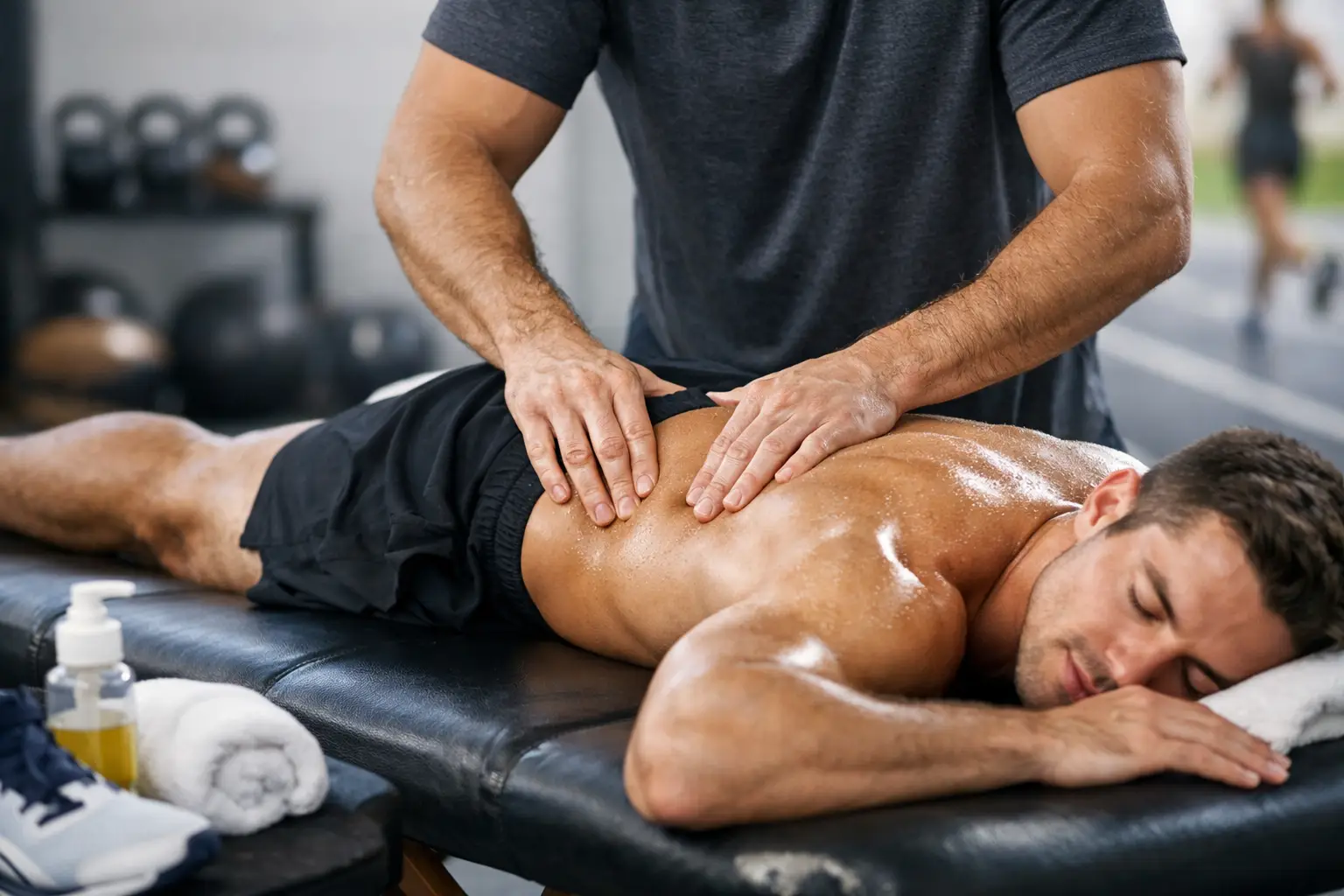
A hard training week can leave you with more than ordinary soreness. Your hip may stop extending cleanly during a sprint. Your shoulder may feel blocked overhead. Your calves may stay loaded long after the workout is over. So, what does sports massage do in practical terms? It helps identify and address the tissue tension, movement restrictions, and recovery bottlenecks that can interfere with training quality.
Sports massage is not a passive spa treatment with a new label. When applied well, it is targeted bodywork built around what your body needs to do next: run, lift, cut, rotate, jump, or return to sport after a setback. The goal is not simply to make a muscle hurt less for an hour. The goal is to improve how you move, recover, and tolerate training over time.
What Does Sports Massage Do for an Athlete?
Sports massage uses hands-on techniques to work with muscle, fascia, tendons, and the nervous system. Pressure, pace, and technique should match your current condition and training demands. A runner with a stiff hip before a race needs a different session than a lifter carrying residual fatigue after heavy deadlifts.
The most immediate effect is often a reduction in the feeling of tightness or guarding. Muscles can feel restricted after repeated loading, hard acceleration, long periods of sitting, poor recovery, or compensation around a painful area. Focused work may reduce that protective tone and make movement feel easier. That can mean a deeper squat, smoother stride, more comfortable shoulder rotation, or less pulling through the hamstring.
It can also improve your awareness of how you are moving. Many athletes know they feel tight but cannot tell whether the issue starts at the ankle, hip, thoracic spine, or shoulder blade. A performance-focused session assesses the pattern, treats the most relevant areas, and gives you a clearer next step for training.
Sports massage does not magically repair tissue damage, erase an injury, or replace intelligent programming. It is one tool in a larger recovery and performance system. Its value comes from applying that tool at the right time and pairing it with movement, strength work, and appropriate load management.
It Can Improve Range of Motion – When the Restriction Is Treatable
Limited mobility is not always a flexibility problem. Sometimes a joint lacks control. Sometimes an irritated tendon makes the body guard the area. Sometimes the restriction is temporary, caused by fatigue and high tissue tone after training. Sports massage can be useful when soft-tissue tension is part of the limitation.
For example, a soccer player may struggle to open the hip after repeated cutting and sprinting. Releasing tension through the hip flexors, adductors, glutes, and surrounding tissue may create more usable range. But that range needs to be reinforced with active movement and strength. If you gain mobility on the table but cannot control it on the field, the change will not hold.
That is why assisted stretching, PNF stretching, and corrective exercise often belong alongside manual therapy. The hands-on work creates an opportunity. The movement work teaches your body to use it.
Better motion is not the same as unlimited motion
More range is not always better. A highly mobile athlete with poor stability does not necessarily need aggressive stretching. They may need strength, coordination, and better control under load. A good sports massage plan responds to the athlete in front of it rather than forcing every body toward the same mobility standard.
It Helps Manage Training-Related Muscle Soreness
After a demanding session, sports massage can reduce the perceived heaviness, stiffness, and soreness that make the next workout feel flat. It may help you feel more prepared to move, especially when recovery time is limited between sessions.
That does not mean you should use massage to ignore fatigue. If your performance is dropping, sleep is poor, pain is increasing, or soreness is lasting longer than expected, the answer may be a lighter training day rather than more pressure on the table. Recovery is not about finding a way to train hard every day. It is about applying enough stress to adapt without exceeding what your body can recover from.
For active adults balancing work, family, and training in Miami, that distinction matters. Heat, travel, disrupted sleep, and inconsistent hydration can add to the recovery load. Targeted bodywork can help, but it works best when it supports a realistic plan for sleep, nutrition, hydration, and programmed training.
It Can Support Injury Prevention, Not Guarantee It
No massage technique can guarantee that you will avoid injury. Sport involves unpredictable forces, contact, fatigue, and occasional mistakes. What sports massage can do is help expose recurring restrictions and compensation patterns before they become harder to manage.
A runner whose calves always tighten after speed work may have limited ankle motion, weak foot control, a rapid jump in mileage, or all three. A racquet sport athlete with recurring shoulder tightness may be overusing the upper trap because the shoulder blade and thoracic spine are not doing enough. Treating the painful spot alone is rarely enough.
A sports-focused practitioner looks for the pattern behind the complaint. Manual therapy may reduce symptoms, while prehab drills, mobility work, and strength training address the demand-capacity gap that created the problem. That is a more useful approach than repeatedly chasing the same knot.
Sports Massage Before Training Versus After Training
Timing changes the purpose of the session. Before competition or a hard workout, sports massage should generally be brief, specific, and activating. The aim is to help you feel loose, switched on, and ready to move without leaving the tissue overly relaxed or sore. Fast-paced techniques, dynamic mobility, and sport-specific preparation make more sense than deep, prolonged pressure.
After training, the goal shifts toward downregulating, restoring comfortable motion, and reducing the sense of accumulated tension. The work can be slower and more focused, but it still should not leave you bruised or unable to train for several days. More intensity is not automatically more effective.
Between major training blocks, deeper work may be appropriate if you have persistent restrictions and sufficient time to recover. The right approach depends on your sport, your weekly volume, your injury history, and what is scheduled next. An athlete preparing for a race this weekend needs a different session than one entering an off-season strength phase.
What a Performance-Focused Session Should Include
A quality session begins with questions. Where do you feel restricted? What training have you completed this week? What movement makes symptoms worse? Is there a recent injury, swelling, numbness, instability, or sharp pain? These details determine whether massage is appropriate and where to focus.
The assessment should also include movement. Watching a squat, lunge, overhead reach, hip rotation, gait pattern, or sport-specific position can reveal more than treating the complaint in isolation. From there, the session may combine deep tissue work, myofascial techniques, assisted stretching, cupping, or dry needling when appropriate and within the practitioner’s scope.
The session should finish with a plan. That may be a simple mobility drill, a change to your warm-up, guidance to reduce volume temporarily, or a strength exercise to improve control. At Roman Balaban Massage Therapy & Fitness Training, this integration matters because recovery work and coaching should point in the same direction: better movement under real athletic demands.
When Sports Massage Is Not the Right First Step
Do not treat sports massage as a substitute for medical evaluation. New severe pain, major swelling, suspected fracture, fever, unexplained bruising, loss of strength, numbness, tingling, or signs of infection require appropriate medical attention. Massage also may need to be modified or avoided around acute injuries, blood-clot risk, certain skin conditions, and some post-surgical situations.
Be direct about what you are feeling. The clearer the history, the safer and more useful the treatment can be. A disciplined athlete does not push through every warning sign. They learn the difference between normal training discomfort and a problem that needs assessment.
Make the Benefits Last Beyond the Table
The strongest results come when massage supports your training instead of standing apart from it. If your hips feel better after a session, use that window to practice quality split squats, controlled hip rotation, or cleaner sprint mechanics. If your shoulders move more freely, reinforce the change with pulling strength, scapular control, and better pressing technique.
Schedule sessions around the demands that matter. Use them after a dense training block, before a return to sport, when a familiar restriction starts changing your mechanics, or during a phase where you are building volume. Avoid waiting until a minor issue has forced you to stop training entirely.
Your body does not need to feel perfect to perform well. It needs enough mobility, strength, coordination, and recovery capacity to handle the work in front of it. Sports massage can help you keep that system moving – provided it is used with purpose, not as a temporary cover for problems your training plan still needs to solve.
Leave a Reply