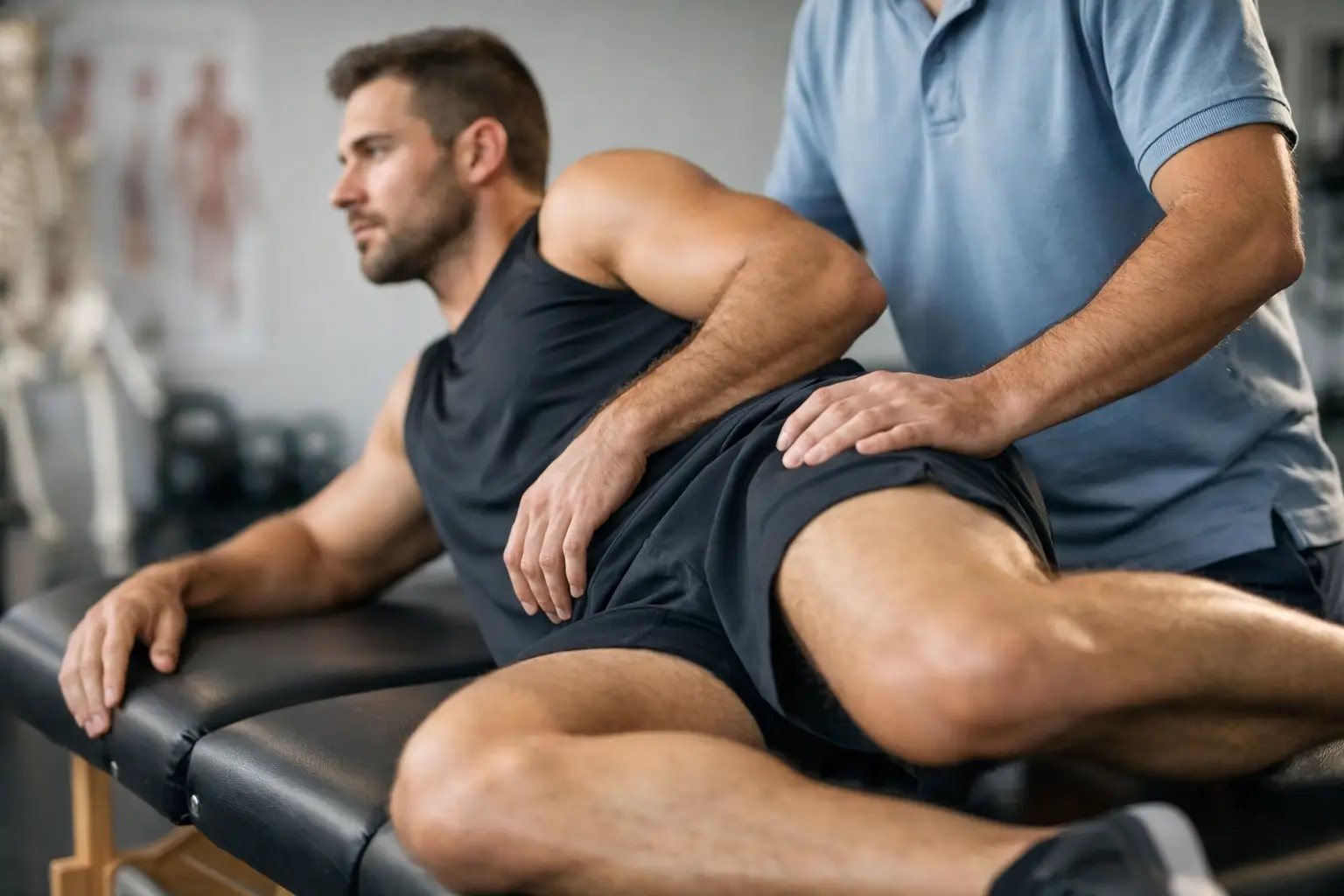
A hard training week rarely breaks down because of one brutal session. More often, performance slips when small restrictions stack up: a hip that no longer extends cleanly, a calf that stays loaded after speed work, a shoulder that compensates during pressing, or an old ankle injury that changes how you run. Manual therapy for performance is built to address those restrictions before they become missed training, altered mechanics, or recurring pain.
This is not passive recovery for the sake of feeling relaxed. For athletes and committed gym-goers, the goal is clear: restore usable movement, reduce unnecessary tension, and return to training with a body that can produce force and tolerate load.
What Manual Therapy for Performance Actually Does
Manual therapy uses skilled hands-on treatment to influence soft tissue quality, joint movement, pain sensitivity, and short-term range of motion. Depending on the athlete’s presentation, that may include targeted deep tissue work, myofascial techniques, assisted stretching, PNF stretching, cupping, or dry needling when appropriate.
The key word is targeted. A runner with persistent calf tightness does not automatically need an hour of calf work. The real driver could be limited ankle motion, poor hip control, a rapid jump in mileage, inadequate recovery, or a strength deficit that forces the calf to do more than its share. Effective treatment starts with movement, training history, and symptoms, then applies the right tool to the right problem.
Manual work can help reduce the feeling of stiffness and improve how a joint or muscle moves in the short term. That window matters. It gives an athlete a better opportunity to reinforce new movement with strength work, mobility drills, technique practice, or a modified training session.
What it does not do is replace training. It will not build sprint mechanics, tendon capacity, or squat strength by itself. The strongest results come when hands-on care and coaching operate as one system.
The Performance Problems It Can Help Address
Athletes often wait until pain becomes disruptive before seeking treatment. That is understandable, but it is not ideal. A better time to act is when a familiar pattern starts changing: your warm-up takes longer, one side feels less stable, recovery between sessions drags, or a movement that normally feels sharp starts feeling restricted.
Manual therapy is especially useful when tightness and discomfort are changing how you train. A soccer player may lose hip rotation and begin overloading the groin. A racquet sport athlete may develop forearm and shoulder tension from repeated serving or swinging. A lifter may struggle to reach an efficient overhead position after high-volume pressing. A runner may feel the same hamstring grab after every speed session.
In these situations, treatment is not about chasing every sore spot. It is about identifying the restriction that is most relevant to the athlete’s goal and current workload. Sometimes the best result is more range of motion. Sometimes it is less pain during a specific pattern. Sometimes it is simply getting a clearer read on whether the athlete needs treatment, a lighter week, better warm-up preparation, or more strength in a weak position.
Why Mobility Alone Is Not Enough
More range of motion is not automatically better. An athlete needs control and strength through the range they use. If you gain hip rotation on the table but cannot control that hip during a cut, sprint, or single-leg landing, the new range has limited value.
That is why manual therapy should lead somewhere. After targeted work, the next step may be a hip stability drill, loaded ankle mobility, controlled rotation, or sport-specific strength exercise. The exact choice depends on the person and the demand. A sprinter needs a different follow-up than a recreational tennis player, even if both arrive with tight hip flexors.
This approach also prevents a common recovery mistake: repeatedly treating the same area without changing the reason it keeps getting irritated. If your lower back is always tight after deadlifts, more back work may provide relief, but it may not solve the issue. Bracing strategy, hip motion, training volume, sleep, and loading progressions all deserve attention.
What a Performance-Focused Session Should Include
A performance session should not begin and end with a generic routine. It should have a purpose tied to your sport, your training week, and your current limitation.
First comes a brief assessment. This may include questions about recent training volume, pain behavior, prior injuries, upcoming events, and what movements feel limited. Movement screens can reveal whether the complaint is local or part of a larger pattern. A tight shoulder may be connected to thoracic stiffness. Repeated hamstring tension may be tied to pelvic control, trunk position, or sprint workload.
Then comes treatment. Deep tissue massage may be useful for dense, overworked areas. Myofascial work can help address restrictions that affect motion across a broader region. Assisted stretching and PNF techniques can improve access to a range that feels guarded. Cupping or dry needling may be appropriate for selected cases, but neither is a magic fix. The modality matters less than the clinical reasoning behind it.
Finally, there should be a plan for what happens next. That may be a short mobility sequence, a strength exercise, a recovery adjustment, or clear guidance on how hard to train in the next 24 to 72 hours. The athlete should leave with direction, not just temporary relief.
Timing Treatment Around Training
The best time for manual therapy depends on the goal. Before competition, aggressive deep tissue work is usually not the move. You want to feel prepared and mobile, not sore or overly relaxed. Light, focused treatment paired with movement preparation may be useful when it helps you access positions needed for the event.
After a demanding session or competition, the priority shifts toward recovery. Treatment can help reduce the sense of accumulated tightness, support relaxation, and make it easier to return to normal movement. Still, recovery is not a single modality. Nutrition, hydration, sleep, total stress, and intelligent programming carry major weight.
During a high-volume training block, regular sessions can help catch restrictions early and keep movement quality from drifting. During a return from injury, manual work may be one part of a larger progression that includes graded loading, strength rebuilding, and sport-specific exposure. It depends on the tissue involved, the athlete’s symptoms, and what the sport demands.
Avoid the “Fix Me” Recovery Trap
The wrong relationship with manual therapy is dependency. If you feel that you cannot train unless someone works on you every week, the plan may be missing capacity-building work. Treatment should support independence, not replace it.
The right relationship is strategic. Use hands-on care when it improves your ability to move, train, and recover. Pair it with the strength, mobility, and load management that make those improvements more durable. Be honest about your training habits. No amount of tissue work can fully offset poor sleep, sudden volume spikes, or repeatedly training through sharp pain.
At Roman Balaban Massage Therapy & Fitness Training, the value of an integrated approach is that treatment does not stop at the table. Manual therapy, assisted mobility, prehab, and gym coaching can be connected to the same performance target, whether that is getting through a race build, returning to field work, or training hard without the same recurring flare-up.
Build a Body That Can Keep Showing Up
The best athletes are not always the ones who train the hardest on a single day. They are the ones who can train well, recover efficiently, and repeat quality work for months. Manual therapy for performance can help protect that consistency when it is used with a clear objective and followed by intelligent movement.
If a restriction keeps changing the way you run, lift, cut, throw, or recover, do not settle for temporary relief alone. Address the tissue, assess the movement, strengthen the weak link, and get back to work with a body prepared for the next session.
Leave a Reply