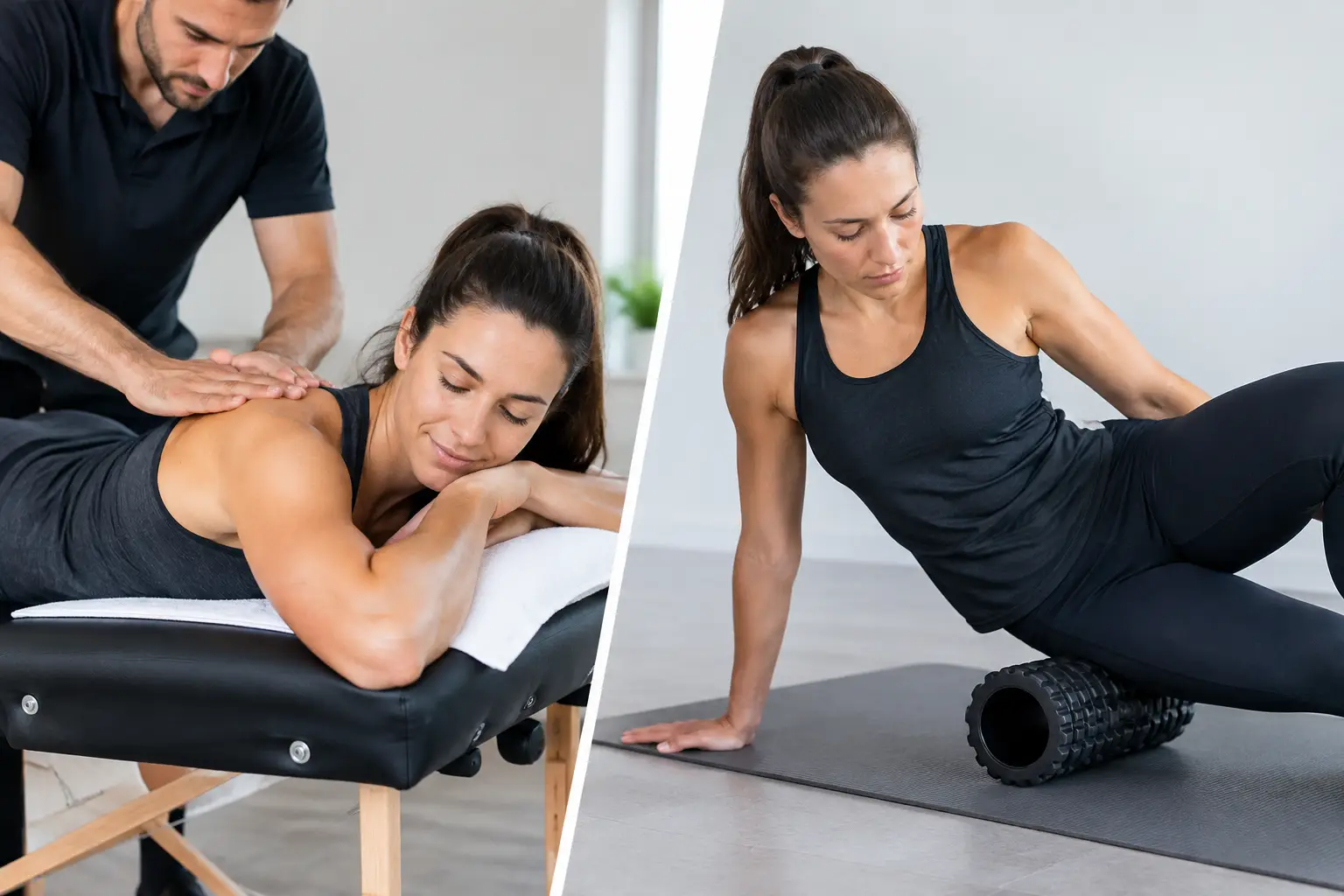
Your calves feel like concrete after hill repeats. Your hip will not open cleanly at the bottom of a squat. You have a foam roller at home, but you also know that 10 minutes of rolling rarely fixes the same restriction twice. Sports massage versus foam rolling is not a contest between a cheap tool and a premium service. They do different jobs, and using the right one at the right time can protect training consistency.
For athletes and serious gym-goers, recovery should support the next quality session. The goal is not to chase soreness or collect temporary relief. It is to improve movement options, manage training stress, and identify the patterns that keep pulling you off your program.
Sports Massage Versus Foam Rolling: The Core Difference
Foam rolling is self-administered pressure. It is accessible, fast, and useful when you need to reduce the feeling of stiffness before training or settle down after a hard session. You control the pressure, duration, and area, which makes it a practical daily recovery tool.
Sports massage is hands-on assessment and treatment. A qualified therapist can feel tissue quality, compare one side to the other, identify where you are guarding, and work around the structures that are actually limiting motion. More importantly, treatment can be paired with assisted stretching, movement testing, and corrective strength work when the issue is not simply local muscle tension.
That distinction matters. A tight hamstring may be responding to repeated sprint volume. It may also be protecting against poor pelvic control, limited hip rotation, or an irritated lower back. Rolling the hamstring may feel good. It may not change the reason it keeps tightening.
Neither approach literally “breaks up” knots or flushes toxins out of the body. Both can influence how your nervous system perceives tension and discomfort, and both can temporarily improve range of motion. Sports massage has the advantage when a trained set of hands needs to determine what is driving the problem and what should happen next.
What Foam Rolling Does Well
Foam rolling earns its place because it is simple and repeatable. Used with intent, it can be an effective part of a warm-up or cooldown, especially for athletes managing normal training fatigue.
Before a run, soccer session, lifting workout, or racquet sport, brief rolling can help you feel less restricted through commonly stiff areas such as the calves, quads, glutes, upper back, and lats. Follow it with active mobility and sport-specific preparation. Rolling alone does not prepare your ankles for cutting, your hips for sprinting, or your shoulders for throwing.
After training, foam rolling can be a low-cost way to downshift and restore a sense of ease in worked muscles. Keep the pressure productive, not punishing. If you are holding your breath, bracing hard, or leaving deep bruises, you are not getting extra recovery value.
Foam rolling is also useful because it teaches body awareness. You may notice that your right calf is consistently more sensitive than the left or that your mid-back feels restricted after long hours at a desk. Those are useful signals. They are not a diagnosis.
Where Foam Rolling Falls Short
The limits show up with persistent or complex problems. A roller cannot assess your gait, check hip control during a single-leg squat, distinguish muscle soreness from tendon irritation, or adjust pressure around a sensitive joint. It is also difficult to target the neck, hip flexors, deep gluteal region, and certain shoulder structures effectively on your own.
There is a behavioral limit too. Many athletes roll the same painful spot every day while ignoring the training load or movement fault that created it. If a spot repeatedly needs aggressive attention, the better question is why it keeps getting overloaded.
When Sports Massage Is the Better Tool
Sports massage is most valuable when recovery needs to be specific. That includes recurring tightness on one side, a mobility loss that affects technique, heavy fatigue during a demanding training block, or the return to normal training after a strain or overload episode.
A performance-focused session should begin with context: what sport you play, what changed in your training, where symptoms appear, and which movements are limited. Treatment can then combine targeted deep tissue work, myofascial techniques, cupping, assisted stretching, or PNF stretching based on what your body presents that day. The method is less important than the result: better movement, reduced protective tension, and a clear plan for the next training session.
For example, a runner with recurring calf tightness may need more than calf work. The session may reveal limited ankle motion, poor foot control, or hip weakness that changes how the lower leg absorbs force. A soccer player with groin tension may need adductor treatment, but also a return to controlled lateral loading before full-speed cutting. This is where manual therapy and coaching belong in the same system.
At Roman Balaban Massage Therapy & Fitness Training, hands-on work is used as a bridge to better movement and more durable training, not as a substitute for strength, conditioning, or smart programming.
What Massage Cannot Replace
Sports massage is not a license to train through a real injury. It cannot repair a torn structure, eliminate poor sleep, or offset a program that increases volume too quickly. The relief can be meaningful, but it should support active recovery work rather than replace it.
It is also not always the right choice immediately before competition. Deep, intense work close to a race or match can leave an athlete feeling sore or flat. Lighter, focused treatment may help some athletes feel ready, while others perform better with a normal warm-up and no additional input. Test your response before an important event, not on game day.
How to Choose Based on Your Situation
Use foam rolling when the issue is mild, familiar, and responsive to a few minutes of self-care. It fits well after ordinary training soreness, before mobility work, or on travel days when you need a simple routine.
Choose sports massage when the issue is recurring, one-sided, affecting mechanics, or not improving with normal recovery. It is also a stronger option during high-volume phases, after a competition, or when you need a professional to connect tissue treatment with a return-to-training plan.
The practical answer for most active adults is both. Foam rolling handles daily maintenance. Sports massage provides periodic assessment, targeted treatment, and adjustments when your body is not responding normally. The frequency depends on your sport, volume, recovery capacity, injury history, and goals. A marathon build, tournament schedule, or return from a strain usually calls for more structured support than two recreational workouts per week.
A Better Recovery Sequence
Do not spend 30 minutes attacking every muscle with a roller. Start with the demand of the day. Before training, use brief rolling only where it helps you move better, then add active range-of-motion drills, activation, and progressive warm-up sets. After training, use light rolling if it feels good, eat, hydrate, and prioritize sleep.
If restriction remains after several sessions, or if the same pattern returns every week, move beyond self-treatment. A sports massage assessment can determine whether the area needs targeted manual work, better mobility, strength at end range, changes to training load, or referral for medical evaluation.
Stop self-treating and seek appropriate care if you have sharp pain, significant swelling, numbness, progressive weakness, unexplained bruising, fever, or pain that changes your walking or running mechanics. Do not aggressively roll directly over an acute injury, a varicose vein, an irritated nerve, or a painful joint.
The best recovery tool is the one that helps you train well tomorrow without creating another problem. Keep the foam roller close, but do not ask it to solve a movement issue that requires assessment, hands-on skill, and a plan.
Leave a Reply