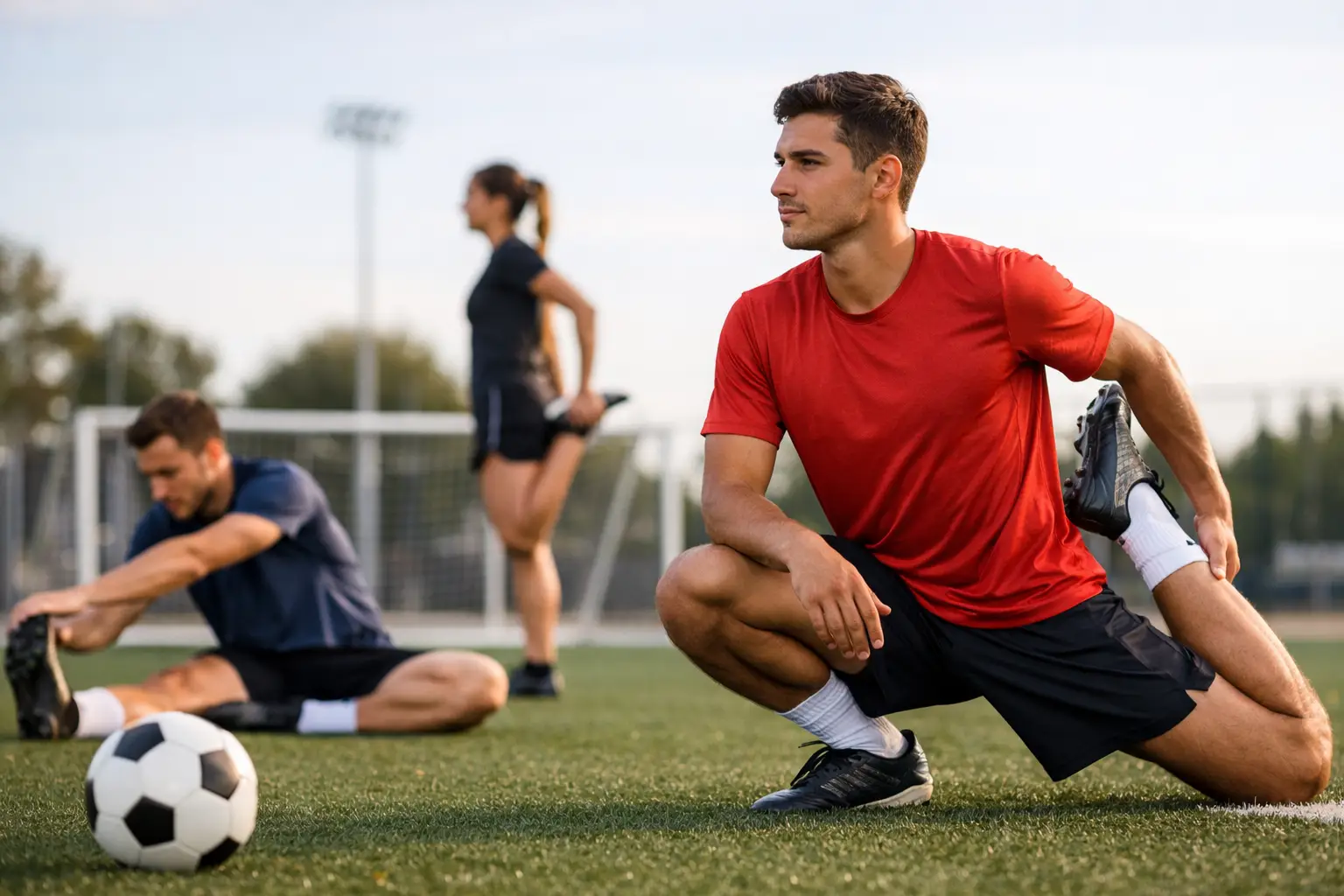
A soccer player rarely breaks down because one muscle is simply “tight.” More often, the problem is a movement restriction that shows up when the game demands a hard cut, a full sprint, a deep tackle, or a powerful strike. The best stretches for soccer players target the joints and tissues that must absorb those demands: ankles, calves, hips, adductors, hamstrings, and the front of the thigh.
Stretching is not a substitute for strength, sound training volume, sleep, or proper recovery. It is a tool for improving usable range of motion and helping you access positions with better control. Used at the right time, it can improve how you warm up, how you move under fatigue, and how well you recover between sessions.
Use the Right Type of Stretch at the Right Time
Before training or a match, your goal is not to become loose. Your goal is to be ready to produce force. Long, passive holds immediately before sprinting or jumping can temporarily reduce muscle stiffness, which is not always what you want when speed and reactivity matter. Start with dynamic mobility and active range-of-motion work, then progress into skips, accelerations, changes of direction, and ball work.
After training, or in a separate mobility session, slower static stretching can help restore range and reduce the feeling of stiffness. Hold each position at a tolerable intensity, breathe normally, and avoid forcing an end range. A stretch should create tension, not sharp pain, tingling, joint pinching, or cramping.
For most players, 6 to 10 minutes of focused mobility before field work and 10 minutes after hard sessions is more useful than one long stretching session once a week. Consistency beats intensity.
Best Stretches for Soccer Players Before Training
Knee-to-Wall Ankle Mobilization
Ankle dorsiflexion is a non-negotiable quality for soccer. You need it to squat, decelerate, get low while defending, push off during a cut, and strike the ground efficiently while sprinting. Limited ankle motion often shifts stress upward into the knee, hip, or lower back.
Face a wall with one foot several inches away. Keep the heel down and drive the knee forward toward the wall without letting the arch collapse inward. If the knee cannot reach the wall, move the foot closer. If it reaches easily, move the foot back. Perform 8 to 12 controlled reps per side, pausing briefly at the end range.
Do not force this drill through the front of the ankle if you feel a sharp pinch. That can indicate a joint restriction rather than a calf issue, and it deserves a more specific assessment.
Adductor Rock-Back
The groin is heavily involved in cutting, lateral shuffling, reaching for tackles, and striking a ball. Yet many players only stretch the adductors with an aggressive wide-leg hold. That approach can irritate an already sensitive groin.
Start on hands and knees. Extend one leg straight out to the side with the foot flat and toes facing forward. Keep a neutral spine, then slowly sit your hips back until you feel tension through the inner thigh. Return forward and repeat for 8 to 10 reps on each side.
This gives the adductors length while keeping the movement controlled. It is especially useful before lateral drills, but it should not replace adductor strengthening. Strong adductors are far more protective than flexible but underloaded ones.
Half-Kneeling Hip Flexor Stretch With Reach
Soccer players spend plenty of time in hip flexion: sitting, driving knees during sprinting, and repeatedly striking the ball. When the front of the hip is restricted, players often compensate by arching the lower back instead of extending the hip.
Set up in a half-kneeling position with one knee on the ground. Gently tuck the pelvis by bringing your belt buckle slightly upward, then squeeze the glute of the kneeling leg. From there, reach the same-side arm overhead and slightly across your body. Hold for one or two breaths, release, and repeat 6 to 8 times per side.
The key is pelvic position. If you lean forward and arch aggressively, you may feel a bigger stretch but get less benefit where you need it.
Active Hamstring Sweep
Hamstrings need to lengthen quickly during top-speed running, then help control the leg as it comes back under the body. An active mobility drill is usually a better pre-training choice than a long seated hamstring hold.
Place one heel on the ground in front of you with the toes pulled up. Keep a slight bend in the standing knee, hinge from the hips, and sweep both hands toward the toes while keeping the back long. Step through and switch sides. Complete 8 to 10 sweeps per leg.
Keep the movement smooth. Bouncing or chasing a maximal range right before sprint work adds little value.
90/90 Hip Switches
Hip rotation matters every time you change direction, open your body to receive a pass, rotate through a shot, or plant and turn under pressure. Limited internal hip rotation can be a major reason a player feels blocked during cuts or overloaded in the groin.
Sit with both knees bent and move them side to side in a controlled 90/90 position. Stay tall through the torso and use your hands behind you only as much as necessary. Perform 6 to 10 slow switches, then spend an extra breath or two in the stiffer direction.
This is a mobility drill, not a contest to force your knees to the floor. Hip anatomy varies. Your objective is controlled, usable rotation, not copying someone else’s range.
Stretches That Earn Their Place After Soccer
Calf Stretch for Both Gastrocnemius and Soleus
The calves take a beating in soccer. They manage repeated push-offs, braking forces, jumps, and rapid changes in pace. Stretch them with the knee straight to bias the gastrocnemius, then with the knee bent to bias the deeper soleus.
Use a wall for support. Keep the rear heel grounded and the foot pointed straight ahead. Hold each version for 30 to 45 seconds per side, breathing steadily. If your Achilles tendon is sore or reactive, use a lighter stretch and prioritize gradual calf-strength work rather than trying to stretch the problem away.
Couch Stretch for Quads and Hip Flexors
Hard sprinting and kicking can leave the quads and hip flexors feeling shortened. The couch stretch can be effective, but it is easy to turn into a lower-back extension drill.
Place one shin against a wall or bench with the other foot in front. Squeeze the glute on the kneeling side, keep ribs stacked over the pelvis, and rise only as high as you can control. Hold for 20 to 40 seconds per side. A mild thigh stretch is enough. If the front of the knee hurts, reduce the angle or choose a half-kneeling variation instead.
Figure-Four Glute Stretch
A figure-four stretch can help after sessions that involve heavy cutting or long periods of running. Lie on your back, cross one ankle over the opposite thigh, and pull the supporting leg toward you until you feel the stretch in the outside of the hip and glute.
Hold for 30 seconds each side. Keep the sensation in the hip, not the knee. If your knee complains, move the crossed foot farther away from the body.
Build a Mobility Routine That Transfers to the Field
A useful soccer mobility routine does not need to include every stretch every day. Match the work to your training and your restriction pattern. If your heels rise early in squats and you feel blocked in deep cuts, spend more time on ankle mobility. If your groin tightens after change-of-direction days, use controlled adductor mobility and make sure your adductor strength program is adequate. If late-game sprint mechanics fall apart, assess hamstring capacity, hip extension, and fatigue management instead of relying on more passive stretching.
A practical pre-field sequence might include knee-to-wall mobilizations, adductor rock-backs, hip flexor reaches, hamstring sweeps, and 90/90 switches. Follow it with progressively faster movement. After training, choose two or three areas that actually feel limited and use static holds without turning recovery into another workout.
Persistent one-sided tightness, recurring groin pain, repeated calf strains, or pinching at the hip are not normal problems to stretch through. Those signals often require a closer look at biomechanics, loading history, strength deficits, and recovery habits. At Roman Balaban Massage Therapy & Fitness Training, assisted stretching and hands-on work are most effective when paired with a plan to improve movement control and sport-specific strength.
The goal is not to be the most flexible player on the field. It is to own the ranges your position demands, stay durable through a full season, and still have speed available when the game gets decisive.
Leave a Reply