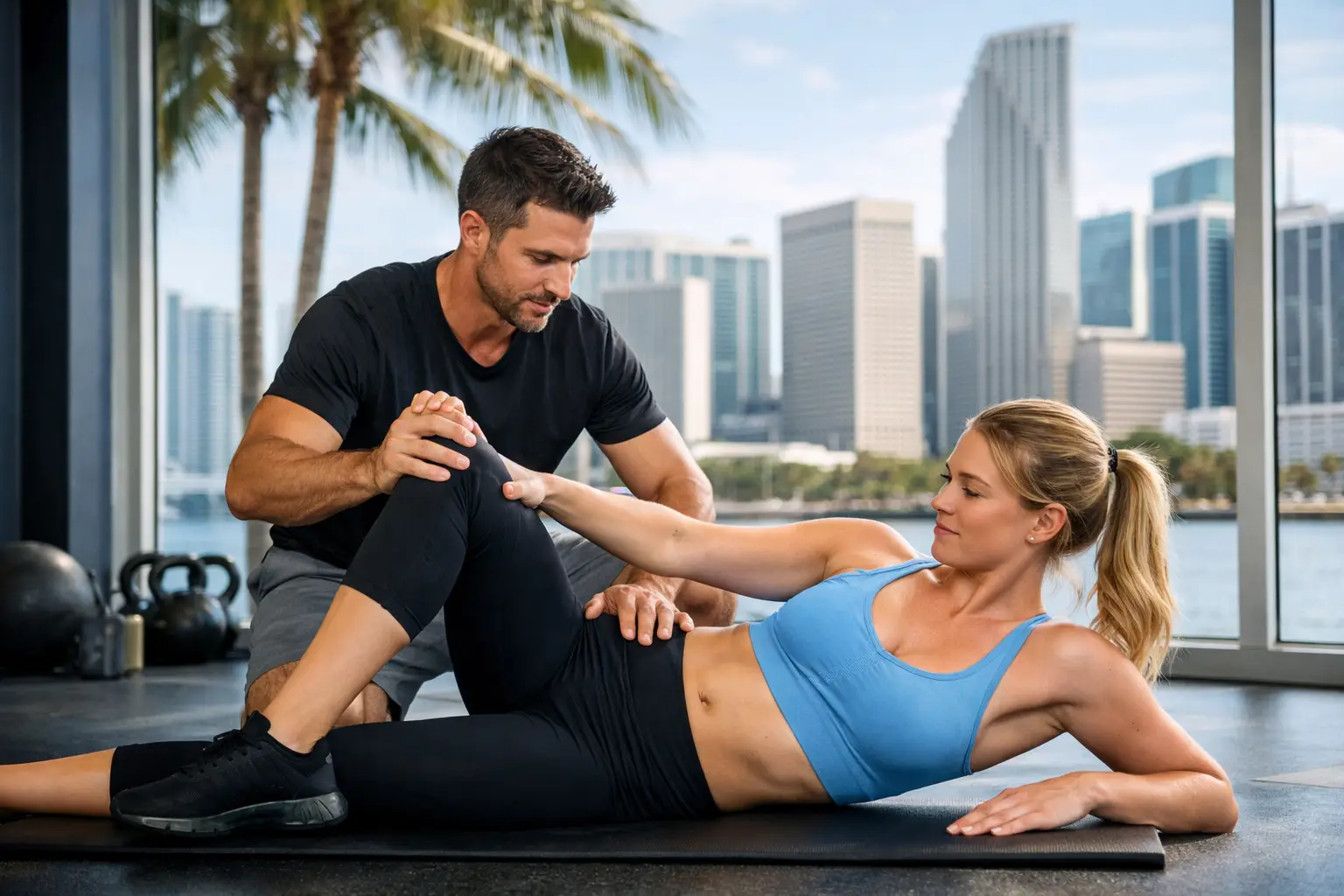
A mobility coach in Miami should do more than help you touch your toes or hold longer stretches. If you train hard, play a field sport, run, lift, or compete on court, mobility needs to show up where it counts: in your squat depth, sprint mechanics, overhead position, hip rotation, and ability to recover before the next session.
Feeling tight is not always the real problem. Sometimes the issue is limited joint control. Sometimes it is tissue that has been overloaded for weeks. Sometimes an old ankle injury has changed how your knee and hip handle force. A useful mobility plan identifies the restriction, addresses it directly, and then teaches your body how to use the new range under load.
Mobility Is Usable Range, Not Just Flexibility
Flexibility is passive range of motion. It describes how far a joint or muscle can move when an outside force helps create the position. Mobility is the ability to control that range on your own.
That distinction matters for athletes. You may be able to pull your knee toward your chest, yet still lose pelvic control at the bottom of a squat. You may have enough shoulder range to reach overhead, but lack the thoracic extension and scapular control needed to press, throw, or swim without irritation.
A mobility coach looks beyond the stretch sensation. The goal is to improve movement quality without sacrificing stability, strength, or sport-specific coordination. More range is not automatically better. Range you cannot control can become another weak point when speed, fatigue, and force enter the equation.
What a Mobility Coach in Miami Should Assess
Mobility work should start with movement, not a generic sequence on a mat. A coach needs to see how your body behaves during the patterns that matter to your training.
For a runner, that may mean looking at ankle dorsiflexion, hip extension, pelvic control, and how the foot accepts load. For a soccer player, it may include hip rotation, adductor capacity, single-leg stability, and the ability to decelerate and change direction. For a lifter, the priority may be squat mechanics, shoulder positioning, thoracic motion, or bracing strategy.
The assessment should also account for your training history. A restriction that appears after a heavy deadlift cycle is different from stiffness that arrives after long hours sitting, frequent travel, or repeated sprint sessions. The right intervention depends on whether the limitation is primarily muscular, joint-related, motor-control based, or driven by excessive training load.
Pain changes the picture as well. Persistent sharp pain, significant swelling, numbness, instability, or loss of strength requires appropriate medical evaluation. Mobility work can support many recovery plans, but it should not pretend to diagnose or replace care when a more serious injury is possible.
Hands-On Work Has a Job to Do
Deep tissue massage, myofascial work, cupping, assisted stretching, and PNF stretching can reduce the feeling of restriction and improve short-term range of motion. For an athlete carrying heavy training fatigue, that change can be valuable. It may make a squat cleaner, help restore a more comfortable stride, or reduce the protective tension that has been building around an irritated area.
But hands-on work is not the entire solution. If treatment creates more range and you immediately return to the same poor movement strategy, the body often goes back to its old pattern. The new range has to be trained.
That is where a combined bodywork and coaching approach earns its value. Roman Balaban Massage Therapy & Fitness Training uses manual therapy to address the immediate restriction, then applies movement, prehab, and strength work to help the athlete keep the improvement. The session is not built around temporary relief alone. It is built around better options for the next training session.
Dry needling may also be appropriate in some cases when muscular trigger points or persistent tone are limiting movement. It is a tool, not a shortcut. The best modality is the one that fits the problem, your tolerance, your training schedule, and the next step in the plan.
The Missing Step: Load the New Range
Mobility that only exists during a slow stretch is fragile. Athletes need to own their range through controlled strength.
If hip rotation improves after manual work, the next step may be a controlled hip rotation drill, a split squat, or a single-leg exercise that asks the pelvis to stay stable. If ankle motion improves, the athlete may need calf strength, foot control, and progressive knee-over-toe loading. If the shoulder moves more freely overhead, the work may shift toward scapular control, carries, pressing, or sport-specific positions.
The exact exercise matters less than the intent. You are teaching the nervous system that the new position is safe, strong, and useful. This is why athletes often get more lasting results from a plan that includes both treatment and training than from passive stretching alone.
There is a trade-off. Loading too aggressively after gaining range can irritate a sensitive area. Staying too cautious for too long can leave the athlete dependent on treatment. A capable coach adjusts the dose based on symptoms, recovery capacity, and the demands of the sport.
Mobility Should Match Your Sport and Calendar
A competitive runner in the middle of a race block does not need the same mobility program as an off-season soccer player. Neither needs the same plan as someone returning to strength training after a low-back flare-up.
During a demanding training phase, the priority is often maintaining enough range and reducing unnecessary tension without creating soreness that disrupts performance. Sessions may be shorter and more targeted. Before an event, the focus should be readiness, not chasing aggressive changes that leave you tender or fatigued.
In an off-season or rebuilding phase, there is more room to address stubborn limitations, strengthen weak positions, and improve movement capacity over time. This is where structured mobility and strength work can make the largest long-term difference.
Miami athletes also deal with heat, high sweat loss, travel, and packed schedules. Dehydration, poor sleep, and accumulated fatigue can all make the body feel tighter than it actually is. Mobility coaching should account for recovery behavior, not simply prescribe more stretching.
Signs You Need More Than a Stretch Routine
A few minutes of daily mobility work can help, especially when it targets a known limitation. But a more individualized approach may be worthwhile when the same issue keeps returning.
Pay attention if your warm-up takes longer every month, one side consistently feels blocked, your performance drops late in sessions, or you keep modifying lifts and drills because a position feels unstable. Recurring calf strains, hamstring tightness, hip pinching, shoulder irritation, and reduced squat depth are not always mobility problems, but they are signals worth assessing.
The same applies when recovery is no longer matching your workload. If soreness lingers, your stride changes after hard sessions, or your body feels stiff despite doing plenty of stretching, the missing piece may be load management, strength in a specific range, or a movement pattern that needs correction.
What Productive Mobility Coaching Looks Like
A good session should leave you with a clear understanding of what is limited, why it may be happening, and what to do between visits. You do not need an overwhelming menu of corrective exercises. You need a few precise actions that fit your training week.
Expect the plan to evolve. If your hip mobility improves but your single-leg control remains poor, the focus should change. If your shoulder feels better but pressing volume keeps triggering symptoms, the program should address load, technique, and recovery rather than repeating the same treatment.
The standard is simple: you should move better in the patterns that matter to you, tolerate training more consistently, and have a plan that makes sense outside the treatment room.
Your body does not need endless maintenance for its own sake. It needs the right amount of hands-on care, strength, recovery, and coaching to keep performing under pressure. Start with the movement that is holding you back, then build the capacity to stop it from becoming the same problem next month.
Leave a Reply