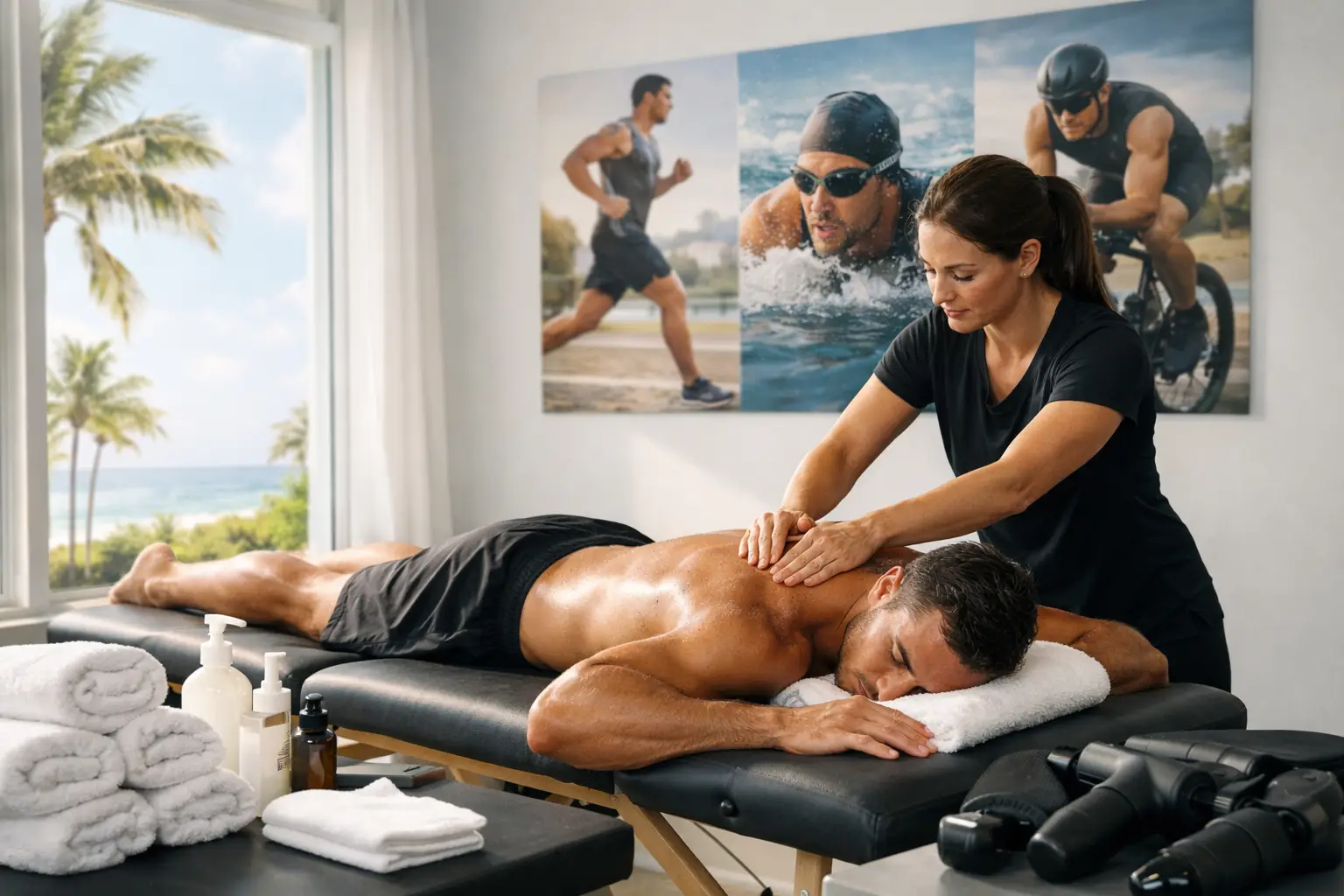
A hard training week leaves clues. Your stride shortens. Your shoulders stop moving cleanly overhead. Your hips feel glued down even after a warm-up. If you are searching for deep tissue massage Miami athletes actually benefit from, the real question is not whether pressure feels intense. It is whether the work improves how your body moves, recovers, and performs.
That distinction matters. A lot of people book deep tissue because they feel tight, sore, or beat up. But for active adults and athletes, tightness is rarely just a comfort issue. It changes mechanics. It limits range where you need it and forces compensation where you do not. Left alone, that can turn a manageable restriction into recurring pain, reduced output, or time away from training.
What deep tissue massage in Miami should actually do
Deep tissue massage is not just harder massage. It is targeted manual work aimed at deeper layers of muscle and fascia, especially in areas that stay chronically overloaded from training, work posture, or repetitive sport patterns. For runners, that may mean calves, hip flexors, glutes, and lateral hip structures. For lifters, it is often pecs, lats, thoracic tissue, forearms, and hip rotators. For court and field athletes, adductors, hamstrings, ankles, and trunk rotation tend to get a lot of attention.
The goal is not to chase pain for its own sake. The goal is to reduce excessive tone, improve tissue glide, restore motion, and make better movement available. Good deep tissue work should help your body accept training better, not just give you 24 hours of feeling looser.
That is why the best sessions are built around function. If your hamstrings keep tightening because your hips are not extending well, smashing the hamstrings alone is incomplete. If your shoulder keeps feeling pinched because your upper back is stiff and your scapula does not move well, more pressure into the front of the shoulder is not the answer. Treatment has to connect to movement.
Why athletes choose deep tissue massage Miami providers offer
In a city full of massage options, athletes need a different standard. Relaxation has its place, but performance-focused bodywork is about outcomes. You want to walk out with a clearer sense of what was restricted, what improved, and what still needs work.
For serious training, deep tissue massage makes the most sense when you are dealing with one of three problems. First, you have accumulated tension that is clearly affecting movement quality. Second, you are carrying repetitive soreness that does not fully resolve between sessions, practices, or matches. Third, you are trying to stay ahead of a pattern that keeps coming back – calf strain history, cranky low back, stubborn neck and shoulder tightness, or hips that lock up every time volume increases.
It also helps during return-to-sport phases, when tissue quality and mobility need attention but random treatment is not enough. In those cases, bodywork works best as part of a larger plan that includes strength, mobility, and load management.
Deep tissue massage is useful, but it depends on timing
More pressure is not always better, and more treatment is not always smarter. Timing matters.
If you are one day out from a race, match, or heavy lift, aggressive work can leave you flat if the tissue response is too strong. Before competition, many athletes do better with a shorter session that opens range, reduces guarding, and prepares movement without creating soreness. After a hard event or training block, deeper work may be more appropriate if the goal is recovery and reset.
The same applies when you are already irritated. If a tissue is inflamed or a nerve is sensitized, forcing deep pressure into it can make symptoms worse. That is where experience matters. A skilled practitioner knows when to work directly, when to work around an area, and when to combine deep tissue with stretching, positional work, or a lighter down-regulation approach.
What a performance-based session looks like
A better session usually starts before the hands-on work. You should be asked what you train, how often, what feels restricted, what movements trigger symptoms, and whether you are preparing for something or recovering from it. That background changes treatment.
From there, the work should be specific. Instead of a generic full-body routine, the session focuses on the areas that are actually limiting performance. A runner with recurring calf tightness may need attention at the foot, soleus, Achilles region, and hip, not just broad pressure through the upper calf. A tennis player with shoulder tightness may need thoracic mobility work, pec and lat release, scapular control, and forearm treatment to really change how the shoulder loads.
This is where integrated care stands out. Deep tissue alone can help, but pairing it with assisted stretching, myofascial work, PNF stretching, or targeted corrective exercise often creates a more durable result. If motion improves on the table but disappears the next day, the missing piece is often what happens after treatment.
Signs you need more than a standard spa massage
If your issue keeps returning despite getting massages, the problem may not be that you need more sessions. You may need a better model.
Standard massage can feel good and still miss the reason a pattern keeps coming back. Athletes often need someone who understands training stress, running mechanics, lifting positions, and how restrictions in one area affect force production somewhere else. When treatment is disconnected from movement, relief tends to be temporary.
This is especially true if you are managing recurring hamstring tightness, limited ankle mobility, hip restriction, shoulder impingement symptoms, or postural tension from desk work layered on top of training. Those patterns respond better when manual therapy is paired with coaching-based thinking: what is overloaded, what is underperforming, and what does your body need to tolerate your actual sport or program?
How often should you get deep tissue massage in Miami?
That depends on your training load, injury history, and goals. Someone training hard five or six days a week may benefit from more consistent work than someone who exercises recreationally three times a week. If you are in the middle of marathon prep, a soccer season, or a return-from-injury build, treatment frequency usually needs to reflect that demand.
For some athletes, every two to four weeks is enough to manage tissue quality and keep movement clean. Others do well with short, focused sessions during heavy blocks, then back off during lower-volume periods. If you only book once pain is already affecting performance, you are using bodywork reactively. That can still help, but it is less efficient than staying ahead of the problem.
The smart approach is to match treatment to demand. Higher stress periods usually justify more support. Lower stress periods may only need maintenance and reassessment.
Choosing the right deep tissue massage Miami practitioner
Do not judge the service by pressure alone. Judge it by relevance.
A good practitioner should understand the difference between sore tissue and weak tissue, between mobility restriction and motor control limitation, and between temporary relief and actual carryover into training. They should ask how you move, not just where it hurts. They should also be able to explain why they are treating certain areas and what you should do after the session.
For athletes, the best fit is often someone who can bridge treatment and performance. That means bodywork informed by biomechanics, recovery methods that match training demands, and practical guidance you can use in the gym or on the field. Roman Balaban Massage Therapy & Fitness Training is built around that model, which is why it makes sense for clients who want more than passive recovery.
What results are realistic?
Deep tissue massage can improve mobility, reduce muscle tension, and help you recover faster between demanding sessions. It can also make training feel cleaner by improving positions you rely on for speed, power, and efficiency. But it is not magic, and it is not a substitute for strength, sleep, hydration, or smart programming.
Some athletes feel a clear shift after one session. Others need a few visits, especially if the issue has been building for months. Chronic restrictions usually respond best when treatment is consistent and paired with changes in movement habits or training structure.
That is the trade-off. Deep tissue can create a fast window of improvement, but long-term durability comes from reinforcing that change. If you treat the tissue and ignore the mechanics, the old pattern usually wins.
If your body feels like it is working harder than your training should require, pay attention. The right hands-on work should not just make you feel better for a day. It should help you move with fewer restrictions, recover with less friction, and show up ready for the next session.
Leave a Reply