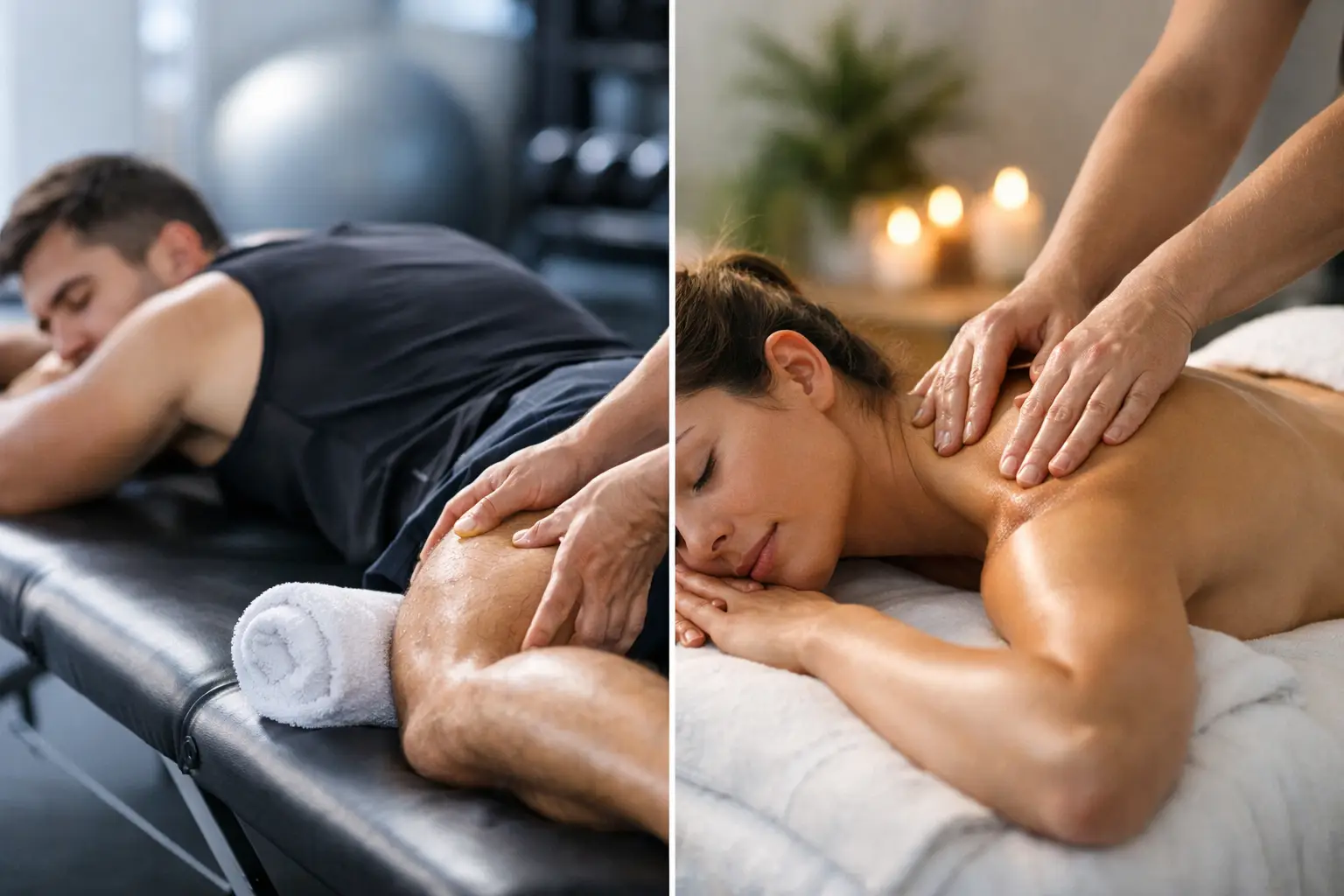
If your calves are locked up after speed work, your shoulders feel glued down from lifting, or your hamstring keeps barking every time training volume climbs, the question is not whether bodywork helps. It’s which type helps most. In the sports massage vs deep tissue conversation, the right answer depends on your training demands, movement restrictions, pain pattern, and timing.
A lot of people treat these two methods like they’re interchangeable. They’re not. Both can reduce tension and improve how your body feels, but they are built for different goals. One is usually organized around performance and recovery in the context of your sport. The other is usually organized around reducing deep muscular restriction and stubborn tissue tension. There is overlap, but overlap does not mean they do the same job.
Sports massage vs deep tissue: the real difference
Sports massage is goal-driven bodywork for people who train. That means the session is shaped by your sport, your current workload, your movement demands, and what your body needs before or after activity. If you run, lift, cycle, play soccer, or train hard several days a week, sports massage is usually built around keeping you moving well, recovering faster, and reducing the chance that small restrictions turn into bigger problems.
Deep tissue massage is more specific to layers of chronic tension and restricted soft tissue. It uses slower, more focused pressure to work through dense areas that feel stiff, bound up, or consistently painful. It is often a strong fit when someone has built-up tightness that does not change with stretching alone, especially in the neck, upper back, glutes, hips, or calves.
The key difference is intent. Sports massage asks, how do we help this person perform and recover better? Deep tissue asks, where is the tissue restricted and how do we change that? Those goals often meet in the same session, but they start from different priorities.
When sports massage makes more sense
If you are actively training, sports massage usually gives you more context-specific value. A runner with overloaded calves and hip flexors does not just need pressure. They need treatment that respects stride mechanics, tissue fatigue, and race or training timing. A soccer player with adductor tightness and a cranky hip does not need generic full-body relaxation. They need work that considers change of direction, sprinting, and groin load.
That is where sports massage stands out. It can be used before competition to improve readiness, after training to reduce residual tightness, or during hard training blocks to keep range of motion and tissue quality from falling off. It is not automatically aggressive. In fact, right before an event, lighter and more targeted work is often the smarter choice.
This is also why serious lifters and hybrid athletes tend to do well with sports massage. Their issue is rarely just “tight muscles.” It is usually a combination of fatigue, movement compensation, local restriction, and poor recovery between sessions. A treatment built around performance tends to address that better than a one-size-fits-all approach.
Good reasons to choose sports massage
Sports massage is often the better option if your symptoms change with training, if you are preparing for an event, if you need to recover between hard sessions, or if the problem shows up in a specific movement pattern instead of staying constant all day. It is especially useful when treatment needs to fit around a program, not interrupt it.
When deep tissue is the better tool
Deep tissue massage is often the right call when you feel chronic, localized restriction that has been building for weeks or months. Think of the upper trap that always feels like a cable, the glute that never releases, or the thoracic area that limits rotation no matter how much mobility work you do.
In those cases, slower and more deliberate pressure can help change tissue tone and reduce guarding. Some athletes need this because they carry years of accumulated stiffness. Others need it because life outside training adds more load than they realize – long drives, desk work, poor sleep, stress, or old injury history.
Deep tissue can also help people who are not in a hard training phase but still want to address restrictions that affect posture, range of motion, and everyday pain. It is not just for athletes, but athletes often benefit from it when specific areas are too dense and reactive to ignore.
That said, more pressure is not always better. If the tissue is already irritated, highly inflamed, or acutely painful, forcing deep pressure into it can make things worse for a day or two. Good treatment is not about proving toughness. It is about using enough force to create change without adding unnecessary strain.
The biggest mistake people make
The most common mistake is choosing by intensity instead of outcome. A lot of people ask for deep tissue because they want a harder session. Harder is not a treatment goal. If you are two days out from a race, heavy deep work into your calves and hamstrings may leave you feeling flat. If you are in the middle of a lifting block and your shoulders are restricted because your thoracic spine is stiff and your scapular control is off, pressure alone may only give temporary relief.
The better question is: what does your body need right now?
Sometimes that means sports massage with focused work, assisted stretching, and movement-based follow-up. Sometimes it means true deep tissue on one or two problem areas, not a punishing full-body session. And sometimes it means bodywork is only part of the answer because the real issue is training load, technique, or recovery habits.
Sports massage vs deep tissue for recovery
If your main goal is recovering from training so you can come back strong for the next session, sports massage usually has the edge. It tends to fit better with athletic scheduling and can be adjusted based on whether you are in-season, peaking, deloading, or rebuilding after time off.
If your main goal is reducing long-standing tissue restriction that keeps limiting your mechanics, deep tissue may be the better short-term tool. But even then, the result lasts longer when it is paired with corrective exercise, mobility work, and changes in how you train.
That matters for active adults who are trying to stay durable, not just feel better for a few hours. A looser hip is useful. A hip that moves better during squats, sprints, and daily life is the real win.
What a serious athlete should look for
For athletes and committed gym-goers, the best treatment is rarely just a massage style. It is an assessment-driven approach. The practitioner should want to know what sport you do, what phase of training you are in, where symptoms show up, what movements are limited, and what you have already tried.
That is why a performance-focused practice like Roman Balaban Massage Therapy & Fitness Training does not treat bodywork as a stand-alone luxury service. The better model is integrated care – manual therapy, mobility work, recovery planning, and training awareness working together. That gives the session a purpose beyond temporary relief.
If your therapist cannot explain why they are using a specific technique, when it fits in your training week, or what you should do afterward, the treatment is missing context.
How to choose the right one for you
Choose sports massage if you are training regularly, preparing for competition, dealing with sport-specific tightness, or trying to stay available for your next session. Choose deep tissue if one or two areas feel chronically bound up, your range of motion is clearly limited, or built-up tissue restriction is driving the problem.
If both descriptions fit, you probably need a session that combines the two. That is common. An athlete may need sports-specific work overall, with deeper tissue treatment in the calves, glutes, or thoracic spine where chronic restrictions live. The best sessions are not loyal to a label. They are loyal to the goal.
The right bodywork should leave you feeling more functional, not just worked over. If you train hard, your recovery should be as intentional as your programming. Choose the method that helps you move cleaner, recover faster, and stay ready for the next demand on your body.
Leave a Reply