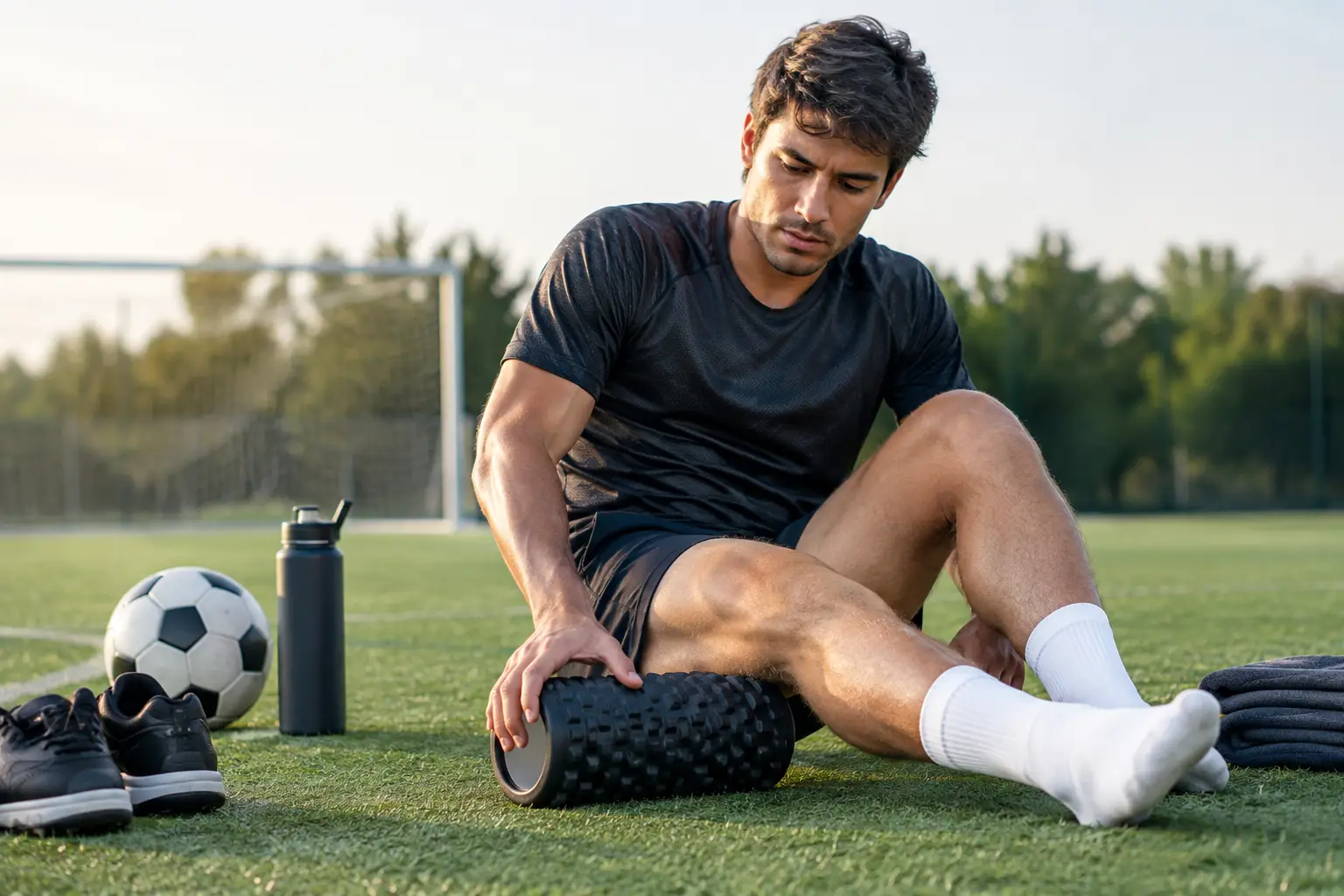
A hard soccer week rarely breaks down because of one match. It breaks down when heavy legs, stiff hips, sore calves, and poor sleep stack up from Monday through Sunday. The best recovery tools for soccer are not the ones that promise instant relief. They are the ones that help you move better, manage training stress, and show up ready for the next session.
Soccer places repeated demands on the same tissues: calves absorb deceleration, adductors control cutting, hip flexors work through sprint mechanics, and hamstrings manage high-speed running. Recovery should support those demands, not just make you feel temporarily loose. A tool is useful when it fits your current problem, your schedule, and your training load.
Best Recovery Tools for Soccer: Start With the Basics
Before buying another device, handle the recovery inputs that affect every system in your body. Sleep, hydration, protein intake, and sufficient carbohydrates are not exciting, but they determine whether your muscles can actually recover from training. No massage gun can compensate for five hours of sleep after a late match or a week of under-fueling.
For players training three or more days per week, aim for consistent sleep timing and a post-training meal that includes both protein and carbohydrates. Carbohydrates matter because soccer depletes glycogen through repeated sprints, changes of direction, and high-volume running. If your legs feel flat two days after a match, the issue may be inadequate recovery nutrition rather than a lack of mobility work.
Think of recovery tools as multipliers. They can reduce stiffness, improve short-term range of motion, and help you maintain a useful routine. They are not replacements for the basics.
Foam Rollers and Massage Balls for Daily Tissue Work
A foam roller remains one of the most practical tools for soccer players because it is inexpensive, portable, and easy to use after training. It works best for broad areas such as the quads, glutes, calves, and upper back. Slow passes with steady pressure can reduce the feeling of tightness and make it easier to move into a mobility session.
Do not turn foam rolling into an endurance event. Spending 10 aggressive minutes grinding directly over a painful spot can leave tissue more irritated, especially after a match. Use moderate pressure for 30 to 60 seconds per area, then follow it with active movement. For example, roll the calves, then perform controlled ankle rocks or calf raises. Roll the glutes, then use bodyweight hip rotations or split-squat holds.
A massage ball is more precise. It is especially useful for the sole of the foot, glute muscles, upper back, and smaller areas around the hip. Use it carefully around the calves and avoid pressing hard into the back of the knee, the groin, or any area with sharp pain, tingling, or numbness.
The trade-off is simple: rolling can make you feel better quickly, but it does not correct the reason a muscle keeps getting overloaded. If one calf tightens after every training session, look beyond the calf. Ankle mobility, foot strength, running volume, and poor deceleration mechanics may be part of the problem.
Massage Guns: Useful, but Not Essential
A percussion massage gun can be a useful addition for players who struggle with post-training soreness or pre-session stiffness. It is convenient for the quads, glutes, calves, and hamstrings, and it can be easier to control than a foam roller when you are fatigued.
Use a low or moderate setting for short intervals. Thirty seconds to two minutes per muscle group is usually enough. Before training, treat it as a preparation tool: use brief exposure, then move through dynamic mobility and warm-up drills. After training, use it to settle down tight areas, not to attack them.
Avoid using a massage gun directly over joints, bones, bruises, swollen tissue, varicose veins, or an acute strain. It should also stay away from the front and side of the neck. If you have a suspected muscle tear, significant swelling, or unexplained pain, get assessed rather than trying to force relief with percussion.
For many soccer players, a massage gun is a convenience purchase, not a priority purchase. If your budget is limited, put money toward good shoes, quality nutrition, strength training, and qualified hands-on assessment first.
Compression Boots for Heavy-Leg Weeks
Compression boots are popular because they feel effective after a demanding match, tournament weekend, or long travel day. They use sequential pressure to create a strong sensation of circulation and can help players feel less heavy and more recovered in the short term.
That short-term effect has value. If you play multiple games in a weekend, have to sit in a car after training, or need to reduce the feeling of lower-leg fatigue before the next day, compression can fit well into the plan. Twenty to 30 minutes while you hydrate and eat can be a realistic recovery habit.
The limitation is that compression boots do not rebuild capacity. They will not strengthen a weak adductor, improve poor landing mechanics, or solve recurring Achilles irritation. Use them for comfort and recovery efficiency, but keep strength work, mobility, and load management in the program.
Players with vascular conditions, active blood clots, severe peripheral neuropathy, or certain cardiac concerns should get medical guidance before using compression devices.
Mobility Bands and Active Range of Motion
Mobility bands are among the best recovery tools for soccer because they can do more than create a sensation of looseness. Used correctly, they help you access positions that soccer demands: hip extension for sprinting, ankle dorsiflexion for deceleration, and hip rotation for cutting and striking.
The key word is active. A band-assisted hip stretch is more useful when you follow it with controlled movement, such as a split squat, lateral lunge, or hip airplane progression. The body needs to own the range it gains. Passive stretching alone may feel good, but it does not always carry over to the field.
For a quick post-training reset, choose two restricted areas rather than stretching everything. A player with limited ankle motion and stiff adductors might spend five minutes on band-assisted ankle work, lateral lunges, and adductor rock-backs. That is more targeted than a random 30-minute stretching routine.
Cold and Heat: Choose the Right Tool for the Situation
Cold exposure can reduce pain and make a sore area feel calmer after a collision, minor knock, or intense match. Ice packs are practical for short-term symptom management, particularly when an area is irritated and warm. But routinely taking long ice baths after every strength or sprint session may not be the best strategy if your goal is to build muscle and adapt to training.
Use cold when pain reduction is the priority. Do not use it automatically because you trained hard.
Heat is often more useful for stiffness, especially before mobility work or on a low-intensity recovery day. A heating pad or warm shower can help a player with stiff hips or calves move more comfortably. Heat is not appropriate for a fresh injury with swelling or significant inflammation.
Both tools change how you feel. Neither one replaces a proper assessment when pain changes your gait, limits sprinting, or returns every week.
Hands-On Recovery and Strength Work Solve Different Problems
At-home tools are valuable, but they cannot fully evaluate movement quality, tissue sensitivity, strength deficits, or the reason one side keeps breaking down. That is where skilled manual therapy and sport-specific coaching matter.
Targeted deep tissue work, myofascial techniques, assisted stretching, cupping, dry needling, and PNF stretching can be useful when they are selected for a clear purpose. The goal is not to collect modalities. The goal is to reduce restriction, restore usable movement, and then reinforce that change with the right strength or control work.
At Roman Balaban Massage Therapy & Fitness Training, recovery is approached as part of athletic preparation. If a midfielder has recurring groin tightness, the answer may include hands-on treatment, hip mobility, adductor strength, trunk control, and a realistic adjustment to weekly load. That is a more durable plan than chasing temporary relief after every game.
Build a Recovery Kit You Will Actually Use
Most players do not need every recovery device on the market. A foam roller or massage ball, a basic mobility band, and a reliable cold or heat option cover most at-home needs. Add a massage gun or compression boots if your schedule, budget, and training volume justify them.
More important than the kit is the routine. Spend 10 focused minutes after training on hydration, food, and the areas that consistently limit your movement. On rest days, use recovery work to prepare for the next session rather than treating it as punishment for the last one.
Your body should feel more capable after recovery, not merely less sore. When stiffness, pain, or fatigue starts changing how you sprint, cut, strike, or land, stop guessing. Address the movement problem before it becomes time away from the field.
Leave a Reply