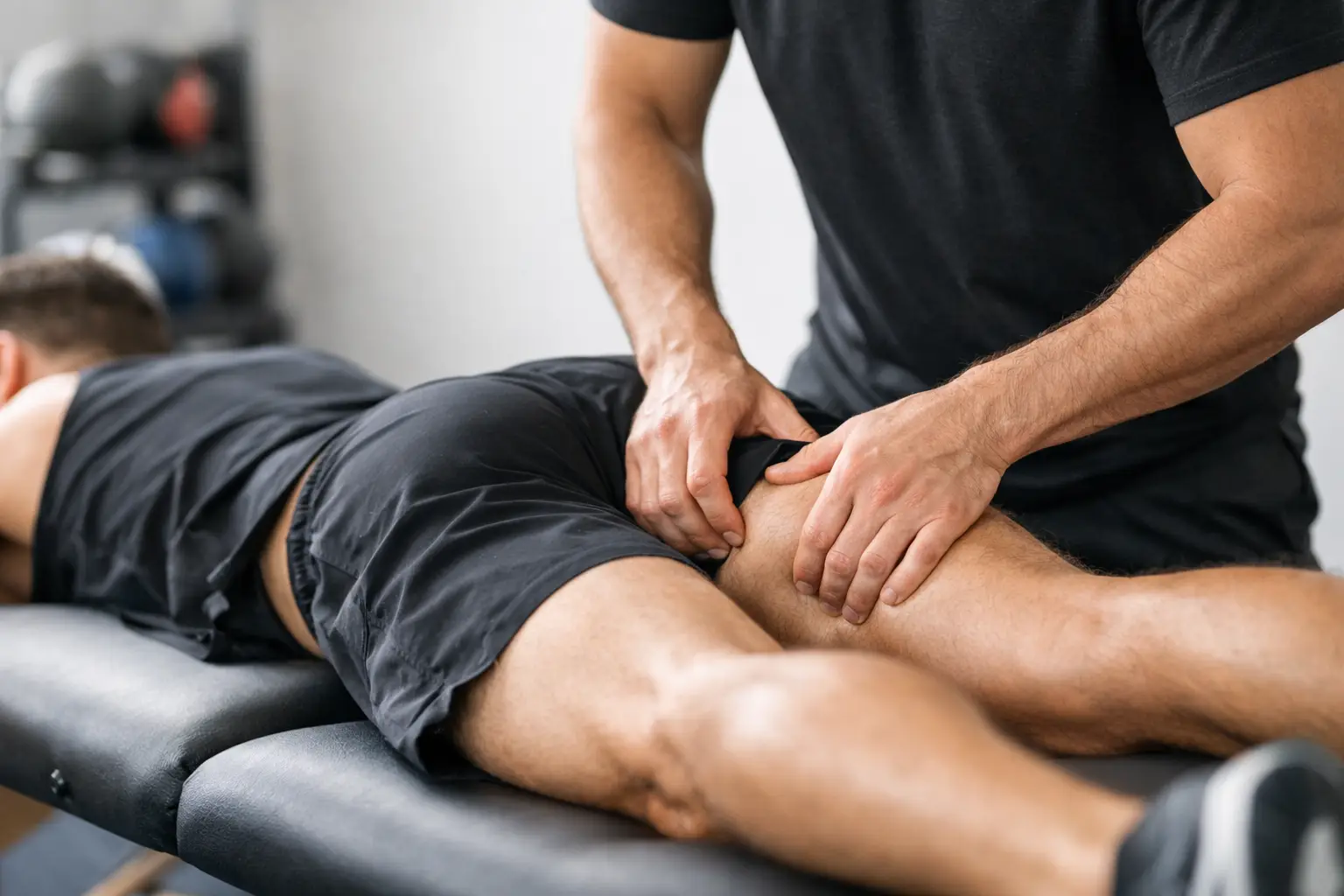
Hamstring tightness changes how you move long before it becomes a full injury. Your stride shortens, your hips stop extending cleanly, sprint speed drops, and simple movements like hinging or kicking start to feel restricted. For athletes and active adults, sports massage for hamstring tightness is not about chasing temporary relief. It is about restoring better tissue quality, improving movement, and reducing the load that keeps building in the wrong places.
A tight hamstring rarely exists in isolation. In most cases, it is part of a bigger pattern involving training volume, poor recovery, limited hip mobility, pelvic position, glute weakness, or nervous system tone. That is why generic massage often falls short. If the work is not specific to the demands of your sport and how your body is compensating, the muscle may feel looser for a day and then lock right back up.
Why hamstrings get tight in the first place
Hamstrings work hard in running, sprinting, field sports, lifting, and change-of-direction training. They help control the leg during swing phase, contribute to hip extension, and absorb force when you decelerate. When training intensity rises, they often carry more stress than they can recover from, especially if glutes are underperforming or the hips and calves are restricting clean mechanics.
Sitting can add another layer, but it is usually not the full story for athletes. Many active people assume tightness means the hamstrings simply need stretching. Sometimes they do. Sometimes they are actually guarding because the tissue is irritated, overloaded, or being asked to stabilize a position that other muscles are not supporting well. If you stretch aggressively in that situation, you may get more irritation instead of better mobility.
This is where assessment matters. The question is not just, “Are the hamstrings tight?” The better question is, “Why are they tight, and what is that tightness doing to your movement?”
How sports massage for hamstring tightness helps
Sports massage for hamstring tightness is most effective when the goal is specific. That may mean reducing post-training tension, improving hip flexion range, easing pulling through the back of the thigh, or preparing the tissue for a return to sprinting. The treatment should match the problem.
Targeted manual work can reduce excessive tone, improve local circulation, and make the tissue more receptive to movement. Deep tissue techniques, myofascial work, and active release approaches can help separate areas that feel dense or guarded. For some athletes, that produces a quick change in how the hamstring lengthens under load. For others, the bigger value is improved tolerance to training over the next few days.
The key point is that massage does not magically “fix” the hamstrings. It creates a window. Inside that window, movement quality often improves, pain sensitivity may drop, and the body becomes easier to coach. That is why the best results usually come when massage is paired with assisted stretching, activation work, and a smart return to loading.
What a performance-focused session should include
If you are an athlete, a hamstring session should not feel random. A performance-focused therapist should look at where you feel the tightness, when it shows up, what training you are doing, and how you move. That includes basic hip motion, pelvic control, lumbar contribution, and whether the restriction is high near the sit bone, mid-belly, or lower near the knee.
Tissue work should match the area and the sport
A distance runner with chronic mid-hamstring tightness may need a different approach than a soccer player who feels repeated pulling high in the hamstring after acceleration. A lifter who gets tight during Romanian deadlifts may need work around posterior chain loading patterns, while a sprinter may need treatment that respects tissue irritability and does not leave the leg flat for speed work the next day.
Pressure alone is not the marker of quality. Effective work is precise. Sometimes that means deep pressure into dense tissue. Sometimes it means slower myofascial work, pin-and-stretch techniques, or PNF stretching after the tissue settles. If the session only chases soreness, it misses the point.
The hips and glutes usually need attention too
Hamstring tightness often improves faster when the surrounding system is addressed. Hip flexors, adductors, glutes, and calves can all change how the hamstrings load. If the pelvis is pulled into a position that keeps the hamstrings under constant tension, local treatment may help, but it may not hold.
That is one reason integrated bodywork matters. In a performance setting, the therapist is not only trying to calm a symptom. The goal is to improve the mechanics that keep feeding it.
When massage works well, and when it is not enough
Massage tends to work well for athletes dealing with accumulated training tension, reduced mobility, protective muscle guarding, or early signs of overload. It can be especially useful during heavy run blocks, tournament periods, high-volume lower-body training, or return-to-play phases when tissue quality needs close management.
It is less effective as a standalone solution if the issue is a true strain, tendon involvement, or repeated reinjury driven by poor sprint mechanics or strength deficits. In those cases, hands-on work may still help, but it should sit inside a larger plan that includes load management, strengthening, and progressive speed exposure.
This is where athletes get frustrated. They feel better after treatment, then tighten up again in the next hard session and assume the massage did not work. Sometimes the massage did exactly what it should. The problem is that the body returned to the same inputs without enough correction. Tissue change without training change rarely lasts.
Sports massage for hamstring tightness before or after training?
It depends on the goal. Before training or competition, the work should be shorter, more targeted, and aimed at improving readiness. The leg should feel more responsive, not heavy or overly relaxed. Aggressive deep work right before sprinting, cutting, or max-effort lifting can backfire if it leaves the tissue flat.
After training, there is usually more room for deeper work and downregulation. This is often the better time to address built-up tone, local adhesions, and post-session stiffness. If you are in the middle of a heavy week, timing matters. You want enough recovery benefit without creating extra soreness that interferes with the next session.
For chronic hamstring tightness, consistency usually beats intensity. Regular, well-timed treatment paired with mobility and strength work tends to outperform occasional hard sessions that only happen when the leg starts barking.
What athletes can do between sessions
The best manual therapy in the world has limits if your recovery habits are poor. If your hamstrings keep tightening up, look at the basics with the same seriousness you give your training. Sleep, hydration, total sprint volume, lower-body lifting fatigue, and warm-up quality all matter.
Between sessions, most athletes do well with controlled mobility, not endless stretching. Hinge patterns, active straight-leg raises, hip flexor mobility, glute activation, and progressive eccentric hamstring loading often support better long-term change than passive stretching alone. If your hamstrings feel tight every day, that is usually a sign to examine how they are being loaded, not just how often they are being stretched.
At Roman Balaban Massage Therapy & Fitness Training, that combined lens matters. Hands-on treatment, movement assessment, and training guidance belong in the same conversation when the goal is performance, not just short-term relief.
Signs you should get the hamstring checked sooner
Not every tight hamstring is just tightness. If you feel sharp pain, bruising, a sudden loss of strength, pain high near the sit bone, or repeated grabbing during acceleration, that deserves a more careful evaluation. The same goes for nerve-like symptoms such as tingling, burning, or pain that travels below the knee. Those cases may need a different treatment plan and a different timeline.
Athletes often wait too long because they can still train around the issue. That usually works until speed, power, or volume rises and the hamstring stops cooperating. Early treatment is usually simpler than managing a problem that has been compensating for six weeks.
A good sports massage session should leave you moving better, not just feeling worked on. If your hamstring keeps tightening up, the answer is rarely more random stretching or another generic massage. The answer is targeted treatment, smarter loading, and a clear look at why the tissue is staying on guard. Get that right, and the hamstrings stop being the weak link in your training.
Leave a Reply