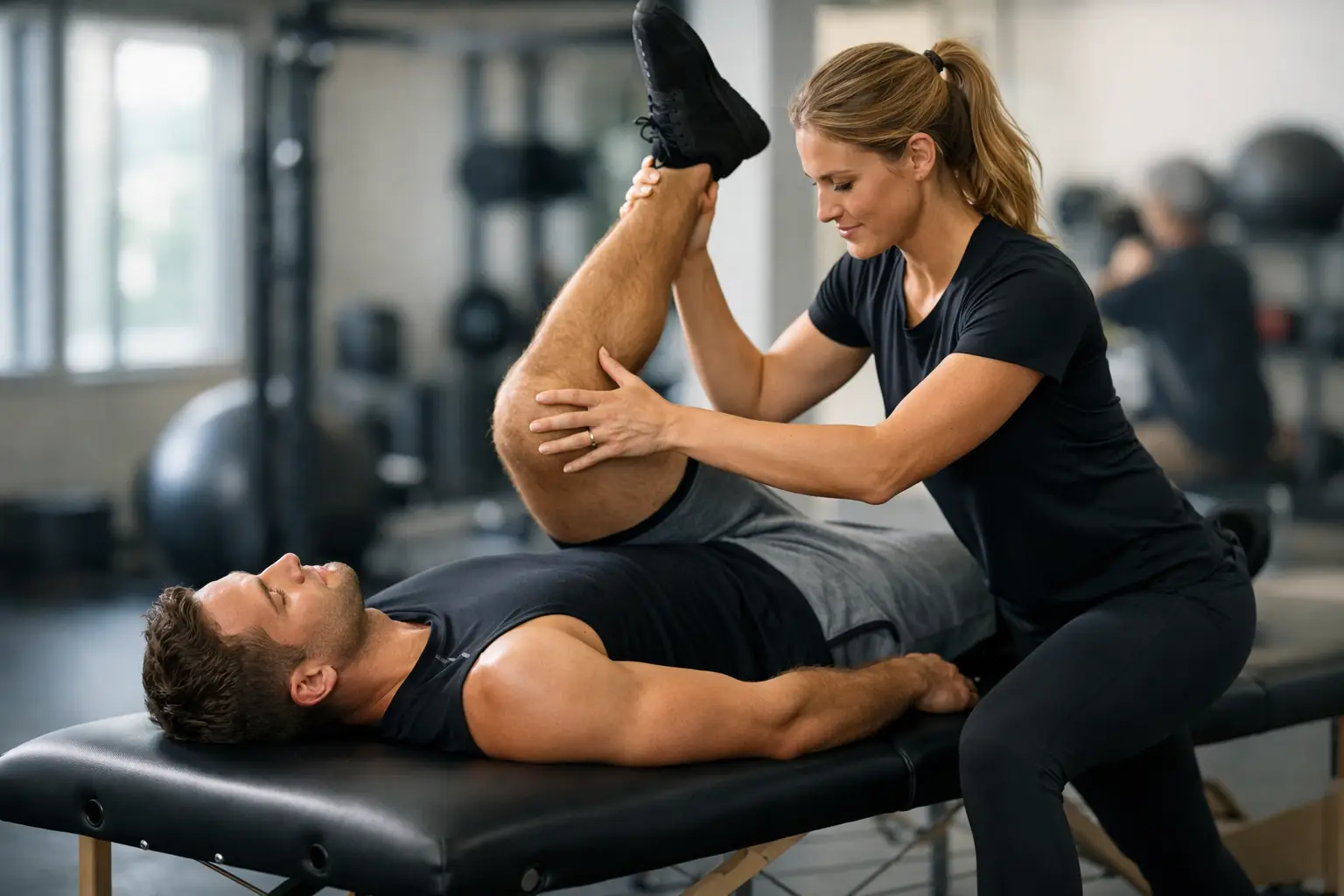
A hard training week leaves clues. Your stride shortens. Your squat shifts forward. Your shoulders stop rotating cleanly overhead. Nothing feels injured, but everything feels a little restricted. That is where assisted stretching for athletes can make a real difference – not as a relaxation add-on, but as a targeted tool to restore usable range of motion and keep movement quality high.
For athletes, mobility is not about looking flexible on a table. It is about accessing the positions your sport demands without wasting energy or compensating through the wrong joints. If hip extension is limited, sprint mechanics suffer. If the thoracic spine is stiff, overhead work gets messy. If calves and hamstrings stay locked up, running and change of direction become less efficient. The point of assisted stretching is to improve the ranges that matter, then make those changes useful in training.
What assisted stretching for athletes actually does
Assisted stretching means a trained practitioner moves your body into specific positions and applies controlled pressure, support, and timing to improve tissue extensibility, joint motion, and neuromuscular control. The key word is controlled. This is not random pulling. It is precise work based on how you move, where you are restricted, and what your sport asks from you.
That matters because many athletes do not just need more range. They need better range in the right places. A runner may need cleaner hip extension and ankle dorsiflexion. A soccer player may need adductor mobility without losing groin stability. A lifter may need shoulder flexion and thoracic extension that carry over to pressing and squatting. Good assisted stretching does not chase flexibility for its own sake. It improves movement options while respecting joint integrity and sport demands.
There is also a major difference between what you can do alone and what a skilled practitioner can help you access. Self-stretching has value, but it is limited by your own positioning, balance, breathing, and ability to relax under tension. External guidance lets the body settle into a stretch more effectively, and it allows for methods like PNF stretching, where contraction and relaxation are used to create measurable changes in range.
Why athletes benefit more than casual exercisers
The more consistently you train, the more your body adapts to repeated patterns. That is part of performance development, but it also creates predictable restrictions. Sprinters get dense through the hip flexors and hamstrings. Lifters build stiffness through the lats, pecs, and ankles. Court and field athletes often carry asymmetries from cutting, kicking, and rotational loading.
For a casual exerciser, minor restrictions may not matter much. For an athlete, small losses in mobility can change mechanics and load distribution. That is when recovery starts taking longer, recurring tightness shows up in the same places, and technique begins to break down under fatigue.
Assisted stretching helps by reducing that buildup before it turns into a bigger problem. It can improve session-to-session recovery, make warm-ups more effective, and help athletes hit cleaner positions in training. It is not a replacement for strength work or movement coaching. It is a support tool that keeps the system moving the way it should.
Where assisted stretching fits in a performance plan
One of the biggest mistakes athletes make is using every recovery tool the same way, regardless of timing. Assisted stretching is useful, but how and when you use it matters.
If you go too aggressive before explosive training, you can lose the stiffness and tension that help with force production. If you wait until restriction has already altered your mechanics for weeks, you are playing catch-up. The best approach depends on the goal.
Before training or competition, assisted stretching should be selective and brief. The aim is to free up restricted areas without dulling output. This works well for athletes who need better hip motion before sprinting, improved shoulder movement before upper-body work, or cleaner ankle mobility before squatting.
After training or on recovery days, deeper work makes more sense. That is when a practitioner can spend more time on stubborn tissue, use techniques like PNF, and address the patterns that accumulate from heavy loading and repetitive movement. This is often where athletes notice the biggest payoff, because the body is no longer fighting to perform in the moment.
During return-to-sport phases, assisted stretching can be even more valuable. After injury, athletes often regain strength before they regain trust in certain positions. Controlled stretching helps restore access to those ranges while reducing the guarding and stiffness that linger after time off.
The difference between helpful stretching and useless stretching
Not all stretching is productive. Some athletes stretch the same muscles every day and still feel tight. That usually means the real issue is being missed.
Sometimes a muscle feels tight because it is overworked, not because it is short. Sometimes a joint above or below is restricted, so another area keeps taking extra load. Sometimes an athlete lacks control in a range, so the nervous system keeps pulling them back from it. In those cases, more stretching alone will not solve much.
This is why assessment matters. A good session should identify whether the limitation is coming from tissue tone, joint mechanics, breathing pattern, training volume, or poor control. Once that is clear, assisted stretching becomes much more effective. You are no longer chasing symptoms. You are addressing the restriction that is actually changing performance.
The trade-off is simple. If stretching creates range but you never reinforce it with strength and movement, the improvement may fade fast. If you only load the body without restoring range where needed, compensation builds. Durable athletes usually need both.
What a quality assisted stretching session should include
A serious athlete should expect more than a generic full-body routine. The session should start with how you are training, what feels restricted, and what movements are being affected. That creates context. A soccer player in-season does not need the same work as a powerlifter in a strength block or a runner coming off a race.
From there, the practitioner should look at the movement patterns that matter most. Hip rotation, extension, ankle dorsiflexion, thoracic rotation, shoulder flexion, and adductor length are common priorities, but the right targets depend on the athlete. The best sessions are built around relevant positions, not a checklist.
Technique matters too. Pressure should be deliberate, not aggressive for the sake of it. Breathing should be coached. Contraction-based methods like PNF should be used with a purpose. And there should be a clear handoff into action, whether that means activation work, mobility drills, or your next training session.
That integrated approach is what separates performance bodywork from spa-style stretching. At Roman Balaban Massage Therapy & Fitness Training, that difference is central – the goal is not to feel loose for an hour, but to move better under load and recover faster for the next session.
Assisted stretching for athletes by sport
The specifics change by discipline. Runners usually need better hip extension, calf mobility, and trunk rotation without making the lower body feel flat. Soccer players often benefit from adductor, hip flexor, and ankle work, especially during dense game schedules. Lifters need access to overhead and squat positions while maintaining enough stiffness to stay strong and stable. Combat and rotational athletes often need thoracic and hip rotation that does not come at the cost of lumbar control.
This is why cookie-cutter mobility plans fall short. The right stretch is not just about the body part. It is about the pattern, the timing, and the demand of the sport.
When athletes should be careful
More is not always better. If a joint is unstable, aggressive stretching can create problems instead of solving them. Hypermobile athletes, for example, often need control and strength more than additional range. Athletes with acute injuries, nerve irritation, or significant inflammation also need a more careful approach.
There is also a difference between discomfort and warning signs. A strong stretch can be intense, but sharp pain, tingling, numbness, or symptoms that linger are not productive. Good assisted stretching should challenge tissue without creating a threat response.
That is why working with someone who understands biomechanics, training stress, and return-to-play demands matters. Athletes need more than flexibility work. They need decision-making that matches the realities of performance.
How to know if it is working
The first sign is not always more range on the table. Often it shows up in movement quality. Your squat feels more centered. Your stride opens up. Your shoulders stack better overhead. Warm-ups get shorter because your body reaches good positions faster.
Recovery can improve too. Athletes often notice less residual tightness after heavy sessions, fewer recurring hot spots, and better tolerance for training volume. Over time, the bigger win is consistency. When your body moves cleanly, you can train hard with fewer interruptions.
The smartest athletes treat assisted stretching as part of maintenance, not emergency repair. If you only address mobility after pain or compensation has built up, progress gets more expensive. If you stay ahead of restriction, you give your body a better chance to perform the way you train it to.
If you care about speed, lifting mechanics, recovery, or simply staying available for the next session, assisted stretching works best when it is specific, measured, and tied to real athletic goals. The body does not need more random recovery. It needs the right input at the right time.
Leave a Reply